Part V - Execution Excellence

The Danger of Almost Done

Listen to Audio
Chapter Illustration

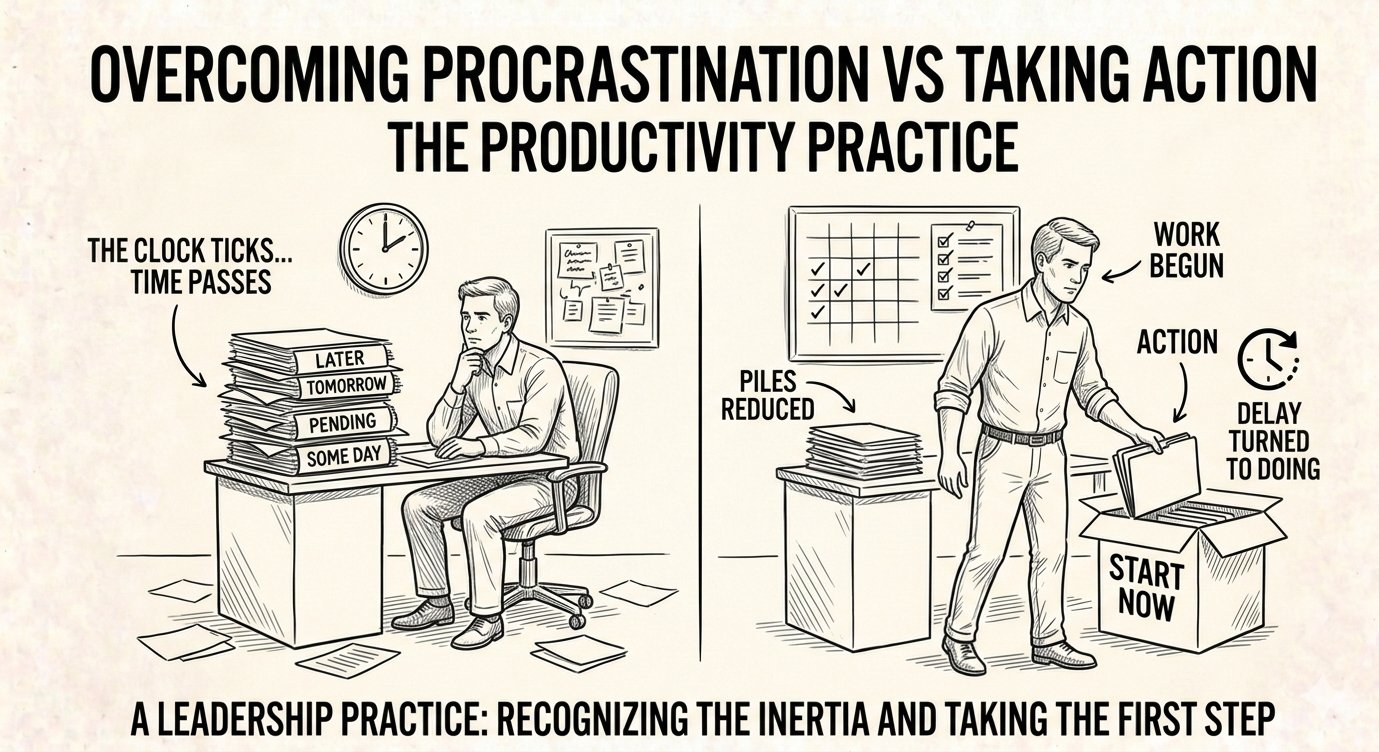
Procrastination is the act of unnecessarily postponing decisions or actions. The main psychological mechanism behind our procrastination is as follows: When we need to get something done, we rely primarily on our self-control in order to bring ourselves to do it. Our self-control often receives support from our motivation, which helps us get things done in a timely manner. In some cases, we experience certain demotivating factors, such as anxiety or fear of failure, which have an opposite effect than our motivation. In addition, we sometimes experience certain hindering factors, such as exhaustion or rewards that are far in the future, which interfere with our self-control and motivation. When demotivating and hindering factors outweigh our self-control and motivation, we end up procrastinating, either indefinitely, or until we reach a point in time when the balance between them shifts in our favor.

Related literature in the field of psychology gives following specific reasons for procrastination - Abstract goals, Rewards that are far in the future, Feeling overwhelmed, Anxiety, Task aversion, Perfectionism, Fear of evaluation or negative feedback, Fear of failure, A perceived lack of control, ADHD, Depression, Lack of motivation, Lack of energy, Sensation seeking etc.,.

In my experience and from what I saw working with many people, I saw these specific reasons and the ways to overcome it :

1. Uninteresting task - When the task is uninteresting but needs to get done, the motivation to do it is low, so people tend to procrastinate. A classic example is the documentation task. People are excited to get the job done, but not that excited to document the work. One of the ways to overcome this problem is to first accept that documentation is critical and is part of the job. I had a colleague who had the habit of documenting the work as he made progress with it and not wait till it is complete. It is almost like keeping a journal of the work done. This way documentation doesn't become a separate task that needs to be dreaded.

2. "Not clear on the final form of the task" - When the task is not clearly defined or it is abstract, there is hesitancy to start and bring clarity. Examples like "writing a paper for a conference" or making a thought presentation. One way to get over this problem, is to first come up with the skeleton/ table of contents - This is one way to remove abstractness and bring clarity. Then one can plan to work on each table of content so that the final paper/presentation can be stitched together.

3. "Student Syndrome" - The tendency to work on a task close to its deadline, like the students who usually prepare for the exam the night before. One needs to understand that Murphy's law (uncertain/urgent event close to deadline) can play spoilsport. By setting an internal deadline which is earlier than the actual deadline, one can address this syndrome.

4. Overwhelming issue - If the issue seems overwhelming then there is a fear that you may not be able to complete it, so you don't want to deal with the situation, hoping that the issue will get resolved without you taking any decision. Addressing the escalation/issue that was brought to your notice about your subordinate, is one such example. If you think addressing this issue is in the best interest of your subordinate, then as a responsible manager, you cannot procrastinate or avoid it. Doing a bit of preparation on how you want to structure the conversation, hearing his side of the story, reposing trust in him are few things you can do to address this issue.

5. Q2 tasks - Important and Not Urgent tasks - The fact that these tasks are not urgent, by design gets procrastinated. There are many examples like fitness goals, networking etc., The only way to get over this issue is to give these tasks its due importance and amplify the future rewards of these tasks, so that it can motivate the person to work on these tasks.

6. Laziness. Among all the reasons for procrastination, laziness is the main culprit.The only mantra to overcome this is to "Just Do It". Don't let your mind play devil, asking your intellect to delay it. As a child I used to fear and respect my father. So whenever he gave me a task, however dull it was, there was no choice but to just do it. Else, I would get reprimanded. I am sure many of us would have feared some person in our life. You can imagine that this person is asking you to do the task that you are postponing, and just do it.

A common way to motivate yourself not to procrastinate is to reward yourself for the progress you make to complete the task. Another approach is to make your commitment to complete the task public, this will put external pressure (to save you face) to complete it.

Why This Matters

Organizational procrastination costs more than individual productivity-it destroys compounding value. When strategic initiatives stall at 95%, when documentation remains incomplete, when decisions get postponed 'until we have more data,' companies forfeit their competitive advantage to more decisive competitors. Leaders who dismiss procrastination as a personal discipline issue miss the systemic dysfunction it signals: misaligned incentives, abstract goals, or overwhelming complexity. In high-velocity markets, the cost of 'almost done' isn't just the delayed project-it's the market opportunity that closes, the talent that disengages, and the organizational learning that never compounds.

Leadership in Practice

Pixar Animation Studios faced an existential procrastination problem during the production of Toy Story 2. Initially planned as a direct-to-video release, the project suffered from perpetual incompleteness-scenes were 'almost done,' character development was 'nearly there,' and story arcs remained 'just about finished.' When John Lasseter screened the 90% complete film, he made a career-defining decision: scrap nearly everything and start over, despite having only nine months until the deadline. The team wasn't lazy; they were trapped in the 'almost done' purgatory where nothing felt quite finished enough to ship. Lasseter's insight was that the procrastination wasn't about effort-it was about unclear standards and abstract goals. He implemented what Pixar now calls the 'Braintrust'-a framework where specific, concrete feedback replaced vague dissatisfaction. Instead of 'this scene doesn't work,' the feedback became 'Woody's motivation in minute 37 contradicts his character arc from minute 12.' This specificity transformed abstract anxiety into concrete action items. The result? Toy Story 2 became both a critical and commercial triumph, grossing nearly $500 million and establishing the creative methodology that would produce Pixar's unprecedented string of successes. The lesson wasn't about working harder-it was about making 'done' a concrete, achievable state rather than an ever-receding mirage.

Leadership Framework

**The Procrastination-Proof Execution Framework**

**Step 1: Make 'Done' Concrete and Visible** Replace abstract completion criteria with specific, observable outcomes. Instead of 'improve customer satisfaction,' define it as 'reduce support ticket resolution time to under 4 hours for 95% of tickets.' Ambiguity breeds procrastination; specificity generates momentum. Create visual progress indicators that make 95% completion as uncomfortable as 0%.

**Step 2: Identify the Hidden Friction** Conduct 'procrastination autopsies' on stalled initiatives. Ask: Is the task uninteresting? Are rewards too distant? Is perfectionism masquerading as quality? Is the task assigned to someone who finds it energy-draining rather than energizing? Most procrastination isn't motivational-it's operational. Map the specific barrier, then engineer around it.

**Step 3: Restructure Incentives for Completion, Not Just Initiation** Organizations celebrate project launches but rarely completion. Reverse this. Implement 'closure bonuses' where the final 10% of a project receives disproportionate recognition. One executive team I advised created a 'Done Wall' where only 100% complete initiatives earned space-no partial credit. This simple visibility shift reduced their portfolio of stalled projects by 60% in one quarter.

**Step 4: Match Tasks to Energy Profiles** Not all procrastination is equal. Documentation drains some people while energizing others. Assign uninteresting-but-essential tasks to team members whose cognitive preferences align with them, or create rotation systems that prevent burnout. When task assignment considers energy profiles, procrastination decreases organically.

**Step 5: Build 'Forcing Functions' Into Your Workflow** Create artificial constraints that make procrastination impossible. Public commitments, staged deadlines with real consequences, and 'definition of done' gates in your project management system transform optional completion into structural necessity. The key is making these forcing functions legitimate constraints, not bureaucratic theater.

**Critical Success Factor:** This framework fails if leaders treat procrastination as a character issue requiring discipline rather than a systems issue requiring redesign. The moment you blame individuals for procrastination, you've lost the ability to fix the underlying workflow dysfunction.

Leadership Takeaway

Starting tomorrow, identify your organization's three most valuable 'almost done' initiatives-the ones stuck at 85-95% completion. For each one, diagnose the specific friction: Is it unclear completion criteria? Mismatched task assignment? Distant rewards? Then apply one concrete intervention from this framework. The leader who systematically eliminates 'almost done' from their vocabulary doesn't just improve productivity-they create a culture where value realization becomes the norm, not the aspiration. Remember: in business, 'almost done' and 'not started' deliver identical customer value.

"The secret of getting ahead is getting started. The secret of getting started is breaking your complex overwhelming tasks into small manageable tasks, and then starting on the first one." — Mark Twain

Ramu Kaka's Wisdom

Beta, the farmer who plants seeds but never harvests has only exhausted himself and depleted his land. In organizations, 'almost done' is the unharvested crop-you've invested everything but realized nothing. Wise leaders know that ten completed projects create more value than fifty almost-finished ones.

Reflection Questions

Comments