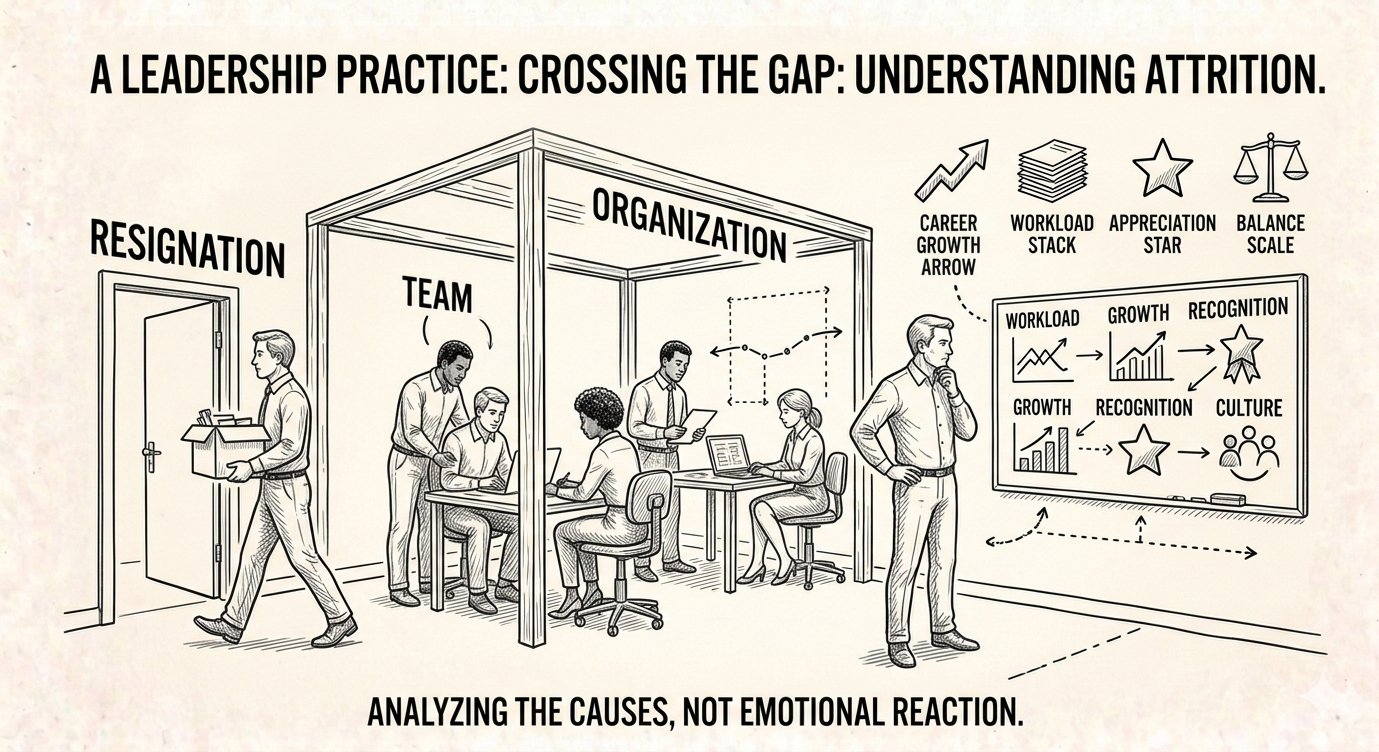
What happens in the psyche of the employee when he is thinking of quitting ? It is common sense that the employee has been brooding about quitting for quite some time. We can divide the process of quitting into three stages. The first stage is when the employee is unhappy with his career in the current organisation. Second stage is when he ventures out and starts to interview with other companies. Third stage is when he has accepted the offer and then puts his paper in the current organisation.
In the first stage, the employee could be unhappy with his career either due to his salary or due to not-so-good manager/Org culture or it could be due to him pursuing his career goals. In this stage, if the company is doing good and in general if the group is doing fine, then the employee may delay pulling the trigger. He hopes that over time his needs will be met in the current company. There could be multiple triggers for him to go the next stage. In the case of salary, if his lifestyle has changed due to events like marriage, then he expects more money sooner, to address his liabilities. In the case of not-so-good manager/organisation, it could be just one bad incident and he may decide to quit. In the third case if he feels he has given enough time to the current organisation or if there are any organisation changes due to which he realises his goal may not be met, then he may decide to quit. In all these cases the employee has given sufficient time before he ventures out. The best time to avoid attrition is in this first stage as the employee has not ventured yet. If the current manager or organisation is not able to assess that the employee is in the first stage, then they have lost a golden opportunity to retain the talent.
It is difficult for a manager to assess the second stage. Clues like random leaves or working from home can help, but given that WFH is common, it is difficult to find. Sometimes if you see the employee spending time with other not-so-common colleagues, then it can be clue. But honestly, a manager cannot be Sherlock Holmes or it may not be morally correct for him to doubt the employee's intention. As assessing that the employee is in the second stage is difficult, so nothing much can be done
The third stage is when the manager/company comes to know about the employee's decision to quit, because the employee informs him. At this stage, 90% of the time it is difficult to retain the person. The decision making process of the employee is skewed in favor of the new company. He will compare the negatives of the current company (he has real data or his assessment of the real data) with the potential positives of the new company. As a manager you risk downplaying the potential positives of the other company and you cannot go too defensive on the negatives of the current company. Both these approaches do not convince the employee. At this stage trying to provide options in other groups that matches with the opportunities of the other company is futile, as the employee has already made up his mind. The employee will go through the motions to keep HR/manager happy so that he can have a comfortable and peaceful exit.
At the third stage, it is very late to take any actions to avoid attrition of the employee. The best bet is in the first stage. Sometimes I feel, isn't it fair on the employee's part to express his intention to seek other opportunities, before he actually does it ? But then if you dig deeper, the right question to ask is : What is the organisation doing to make the employee feel comfortable to have such difficult & crucial conversation? So the solution to avoid attrition is not after the employee has puts his paper, but to build an organisation where the employees can trust the system & managers to freely express their career issues. This starts with purposeful yearly development plan discussions, creating right career opportunities, competitive compensation, fair appraisal process and creating a good work culture.
Why This Matters
Employee attrition directly impacts your bottom line through recruitment costs averaging 50-200% of annual salary, productivity losses during transition periods, and the erosion of institutional knowledge that takes years to rebuild. More critically, high-performing employees rarely leave in isolation-their departure often triggers cluster resignations that can destabilize entire teams. Leaders who fail to recognize early-stage dissatisfaction don't just lose individual contributors; they lose their pipeline of future leaders and signal to remaining employees that the organization doesn't invest in retention until it's too late.
Leadership in Practice
When the new CEO became a major technology company CEO several years ago, he inherited an organization hemorrhaging top talent, particularly among engineers and product managers who felt stifled by internal politics and stack-ranking performance systems. The company's attrition rate among high performers had reached crisis levels, with many leaving for competitors like a major tech company and the company. The CEO recognized that exit interviews revealed symptoms, not causes-employees were leaving long before they submitted resignations. He implemented "connection" as a core leadership metric, requiring managers to conduct monthly career conversations separate from performance reviews. These weren't checkbox exercises but substantive discussions about individual aspirations, skill development, and organizational fit. The CEO personally modeled this behavior, holding skip-level meetings focused exclusively on employee growth rather than project updates. He eliminated the forced-curve ranking system that had created internal competition and replaced it with collaborative goals. Critically, he empowered managers to make retention decisions at the team level, providing budget flexibility for compensation adjustments, role redesigns, and lateral moves before employees entered the job market. The results were measurable: over the following years, the company's regrettable attrition rate among high performers dropped by 35%, and the company's reputation on employer review sites dramatically improved. More importantly, the culture shift enabled the company to retain the engineering talent necessary for their successful cloud transformation. The CEO's approach demonstrated that retention isn't about counter-offers; it's about creating conditions where employees never reach the decision to explore alternatives.
Leadership Framework
**The Early Detection Retention Framework (EDRF)**
**Stage 1: Establish Continuous Connection**
Schedule monthly 30-minute career conversations completely separate from performance discussions or project updates. Use the ACE structure: Aspirations (where does the employee want to be in 2-3 years?), Challenges (what obstacles do they face currently?), and Enablers (what resources or changes would accelerate their growth?). Document these conversations and track progress on commitments you make. Critical success factor: These cannot be delegated to HR or treated as optional during busy periods-inconsistency signals that you don't genuinely care.
**Stage 2: Monitor Leading Indicators**
Track behavioral patterns that signal stage-one dissatisfaction: decreased participation in voluntary activities, reduced contribution in meetings, withdrawal from social interactions, increased focus on task completion over innovation, or subtle changes in communication patterns. Create a simple monthly reflection: "Which team members am I worried about, and what specific evidence supports that concern?" Warning: Don't confuse introversion or personal life challenges with disengagement-verify your concerns through direct conversation, not assumption.
**Stage 3: Conduct Proactive Stay Interviews**
Quarterly, ask high-performers and critical team members: "What would make you leave?" and "What makes you stay?" This isn't about creating anxiety; it's about surfacing issues while you can still address them. The key is responding with action, not justification. If an employee expresses concerns about compensation, career path, or team dynamics, your response timeline matters-waiting for the next review cycle often means waiting too long.
**Stage 4: Build Retention Authority at the Manager Level**
Advocate for budget flexibility that allows spot bonuses, off-cycle raises, role adjustments, or project reassignments without requiring three layers of approval. Retention decisions made in days succeed; those requiring weeks of bureaucracy fail. Equip yourself with competitive market data so you can make informed decisions quickly.
**Stage 5: Create Graceful Exit Pathways**
Paradoxically, organizations that make internal mobility easy-allowing employees to explore different teams, functions, or locations-reduce external attrition. An employee who changes roles internally is a retention success, not a failure. Remove the stigma around internal exploration; the alternative is external exploration.
Leadership Takeaway
The most expensive retention strategy is the counter-offer; the most effective is the conversation that prevents the job search from ever beginning. Starting tomorrow, schedule 30-minute career conversations with each direct report focused exclusively on their growth, not your projects. Ask one question: "What would need to change for you to see your next three career moves happening here?" Then listen without defensiveness and commit to one specific action within two weeks. Retention is won in moments of connection, not crisis.
"People don't leave companies, they leave managers. But more accurately, they leave managers who never asked what they needed to stay." — Marcus Buckingham, leadership researcher and author
Ramu Kaka's Wisdom
The wise gardener doesn't wait for the plant to wilt before watering it. By then, the roots have already begun searching for moisture elsewhere. Tend to your people before they thirst, and they'll never need to look beyond your garden.
Reflection Questions
- When was the last time I had a conversation with each direct report focused exclusively on their career aspirations rather than current project deliverables, and what did I learn about their long-term satisfaction?
- If my three highest performers resigned tomorrow, would I be genuinely surprised, or have I noticed warning signs that I've been too busy or uncomfortable to address?
- What organizational barriers prevent me from making rapid retention decisions when I identify at-risk talent, and what specific actions can I take this month to increase my autonomy in this area?
Comments