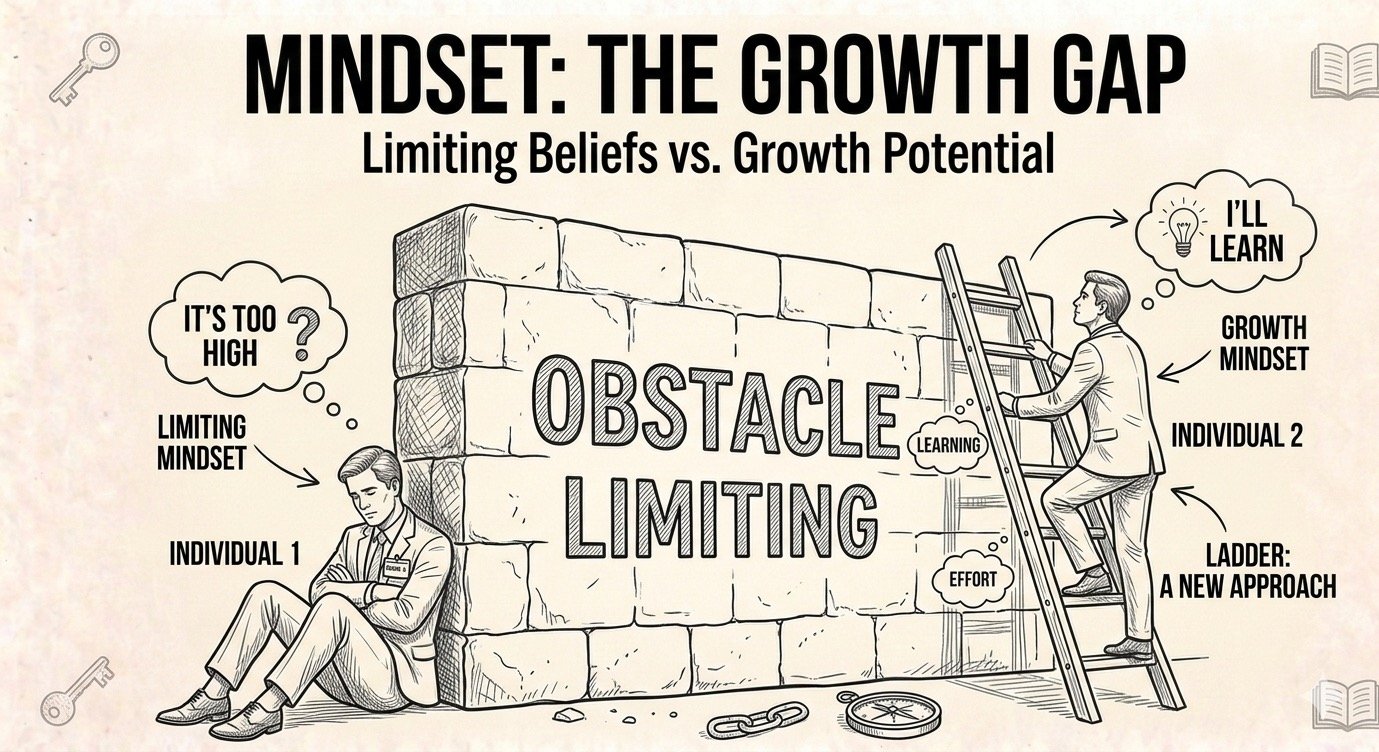
A simple belief about yourself guides a large part of your life. Much of what you think of as your personality actually grows out of this "mindset".
If you think your qualities were carved in stone - You were smart or you weren't, and failure meant you weren't. If you have certain amount of intelligence, a certain personality, and a certain moral character - well then you better prove that you have a healthy dose of them. If you think success is about proving you're smart or talented. If you don't succeed, you probably don't have the ability. Then this belief makes you a person of "Fixed Mindset".
There's another mindset in which these traits are not simply a hand you're dealt and have to live with. In this mindset, the hand you're dealt is just the starting point for development. This mindset is based on the belief that your basic qualities are things that you can cultivate through your efforts. The belief that cherished qualities can be developed creates a passion for learning. The passion for stretching yourself and sticking to it, even when it's not going well, is the hallmark of the "Growth Mindset".
In one world - the world of fixed traits - success is about proving you're smart or talented. In the other - the world of growth mindset - it's about stretching yourself to learn something new. In one world, failure is about having a setback. Getting rejected. In the other world, failure is about not growing. It means you're not fulfilling your potential. In one world, effort is bad thing. It, like failure, means you're not smart. If you were, then you wouldn't need effort. In the other world, effort is what makes you smart or talented. In one world, everything is about the outcome. In the other world, you give your best regardless of the outcome. In one world, if things gets too challenging - when you're not feeling smart of talented- you lose interest. In the other world, you thrive on challenges as it provides good opportunity for learning. In one world, confidence becomes fragile due to setbacks (outcome focused), in the other world you may not need the confidence as you are not afraid of setbacks and you are keen in the learning experience.
Alfred Binet, the inventor of IQ, designed it to identify children who were not profiting from Paris public schools. IQ test wasn't meant to summarize a person's unchangeable intelligence. Albert Binet says that with practice and training one can manage to increase one's attention, memory and judgement, to literally become more intelligent than before. Intelligence is not a fixed prior ability, but with purposeful engagement one can achieve expertise.
So what you think is your mindset - Fixed or Growth?
You have a choice.
Mindsets are just beliefs. They're powerful beliefs, but they're just something in your mind, and you can change your mind.
The mindset that you adopt for yourself profoundly affects the way you lead your life.
Why This Matters
Research across education, business, sports, and personal development consistently demonstrates that mindset shapes outcomes independent of initial ability. Two people with identical starting capabilities but different mindsets will diverge dramatically over time-the fixed mindset person stagnates or declines when facing challenges, while the growth mindset person continues developing through those same challenges. Organizations increasingly recognize that hiring for growth mindset matters as much as hiring for current skills, because growth mindset individuals continuously expand their capabilities while fixed mindset individuals plateau regardless of talent. In rapidly changing industries where what you know becomes obsolete quickly, the willingness and ability to continuously learn matters more than any particular expertise. Mindset isn't soft psychology-it's the fundamental factor determining whether you'll adapt, grow, and thrive in a changing professional landscape, or stagnate while protecting the illusion of fixed competence.
Leadership in Practice
A major technology company hired two software engineers with comparable technical skills and academic credentials. Over five years, their trajectories diverged dramatically. The first engineer consistently sought the most challenging projects, viewing difficulty as opportunity for learning. When stuck on problems, they'd spend hours researching, experimenting, and seeking advice. They openly discussed mistakes in code reviews, treating each as a learning moment. When technologies they'd mastered became obsolete, they'd invest evenings and weekends learning replacement technologies. After five years, they'd become one of the most versatile and valuable engineers on the team, capable of solving problems across multiple domains.
The second engineer, equally talented initially, gravitated toward familiar technologies and well-defined problems where they could demonstrate existing expertise. When projects ventured into unfamiliar territory, they'd express doubt about fit rather than enthusiasm for learning. Mistakes in code reviews were defended or minimized rather than explored for lessons. When their primary technology became less central to company strategy, they resisted learning new approaches, arguing their existing expertise was being underutilized. After five years, their skillset had become progressively less relevant, and what had been confidence had transformed into defensiveness.
The difference wasn't initial ability or even work ethic-both worked hard. The difference was mindset. One viewed capabilities as fixed traits to be demonstrated; the other viewed them as qualities to be developed. That single difference compounded over time into entirely different career trajectories. The company eventually promoted the first engineer to technical leadership while the second engineer left, frustrated by lack of advancement they attributed to politics rather than their own stagnation.
Leadership Framework
**The Growth Mindset Cultivation Framework**
**1. Reframe Challenge as Opportunity**
When facing difficult situations, consciously reframe your internal dialogue: Replace "This is too hard" with "This is hard-that means there's something valuable to learn." Replace "I can't do this" with "I can't do this YET." The simple addition of "yet" transforms fixed limitation into temporary status on a development path.
**2. Embrace Effort as Growth Mechanism**
Stop viewing effort as evidence of inadequacy: High performers in any field invest enormous effort mastering their craft. Effort isn't the opposite of talent; it's how talent develops. When you find yourself working hard, remind yourself: "This effort is making me more capable." Celebrate struggle as evidence of growth, not failure.
**3. Extract Learning from Failure**
Systematically mine setbacks for lessons: After failures or mistakes, ask explicitly: "What can I learn from this?" Document those lessons. Share them with others. Treat failure as expensive education that you should extract maximum value from. The person who learns from failure grows; the person who avoids examining failure repeats it.
**4. Seek Challenge Actively**
Don't wait for growth opportunities to find you: Volunteer for projects at the edge of your comfort zone. Ask for feedback on weaknesses, not just strengths. Take on stretch assignments that will expose gaps in your capabilities. Each challenge accepted is an investment in future capability.
**5. View Others' Success as Information**
When colleagues succeed, especially at things you struggle with, resist the fixed mindset urge to feel threatened: Instead ask: "What's their approach? What can I learn from how they tackled this?" Others' success isn't evidence of your inadequacy; it's a curriculum for your development.
**6. Provide Growth-Mindset Feedback**
When leading others, emphasize effort, strategy, and learning rather than just praising talent: Replace "You're so smart!" with "Your systematic approach really paid off." Replace "You're naturally good at this" with "Your practice and persistence built this skill." This cultivates growth mindset in your team.
**7. Embrace "Not Yet" Culture**
In your team or organization, replace language of permanent limitation with language of development: Replace "I'm not technical" with "I haven't developed technical skills yet." Replace "That's not my strength" with "I'm still developing that capability." Language shapes belief, and belief shapes action.
**Critical Success Factor**: Mindset isn't just optimistic thinking-it's fundamental belief that shapes how you interpret experiences and what actions you take. You can't simply decide to have growth mindset in one area while maintaining fixed mindset in others. The transition requires examining your core beliefs about intelligence, talent, and capability, then consciously choosing to view them as developable. This is uncomfortable because it means accepting that your current limitations reflect current development status, not permanent capacity. But that discomfort is liberating-it means there's always potential for growth.
Leadership Takeaway
This week, audit your mindset honestly: When you face a difficult challenge, do you think "Can I do this?" (fixed) or "How can I figure this out?" (growth)? When you see talented colleagues, do you feel threatened or curious? When you work hard, do you feel inadequate or engaged in growth? Where you identify fixed mindset patterns, consciously reframe them using growth mindset language. Remember: you have a choice. Mindsets are powerful beliefs, but they're beliefs-and beliefs can change. The mindset you adopt profoundly affects how you lead your life. Choose growth.
"The mindset that you adopt for yourself profoundly affects the way you lead your life." - Carol Dweck, whose research established the science of mindset
Ramu Kaka's Wisdom
The farmer who believes soil fertility is fixed will plant the same crops year after year until the land is exhausted. The farmer who understands soil can be enriched will continuously improve it through composting, rotation, and care-and the land becomes more productive over time. Your mind is like soil-it grows what you cultivate. Believe it's fixed, and it becomes so. Believe it develops, and it does.
Reflection Questions
- When you encounter something difficult or unfamiliar, is your first thought "Can I do this?" or "How will I learn to do this?"-and what does that reveal about your mindset?
- Looking back at your career, where did you avoid challenges because you feared exposing inadequacy-and what capabilities did that avoidance cost you?
- If you truly believed your intelligence, skills, and talents were fundamentally developable through effort, what would you attempt that you are currently avoiding?
Comments