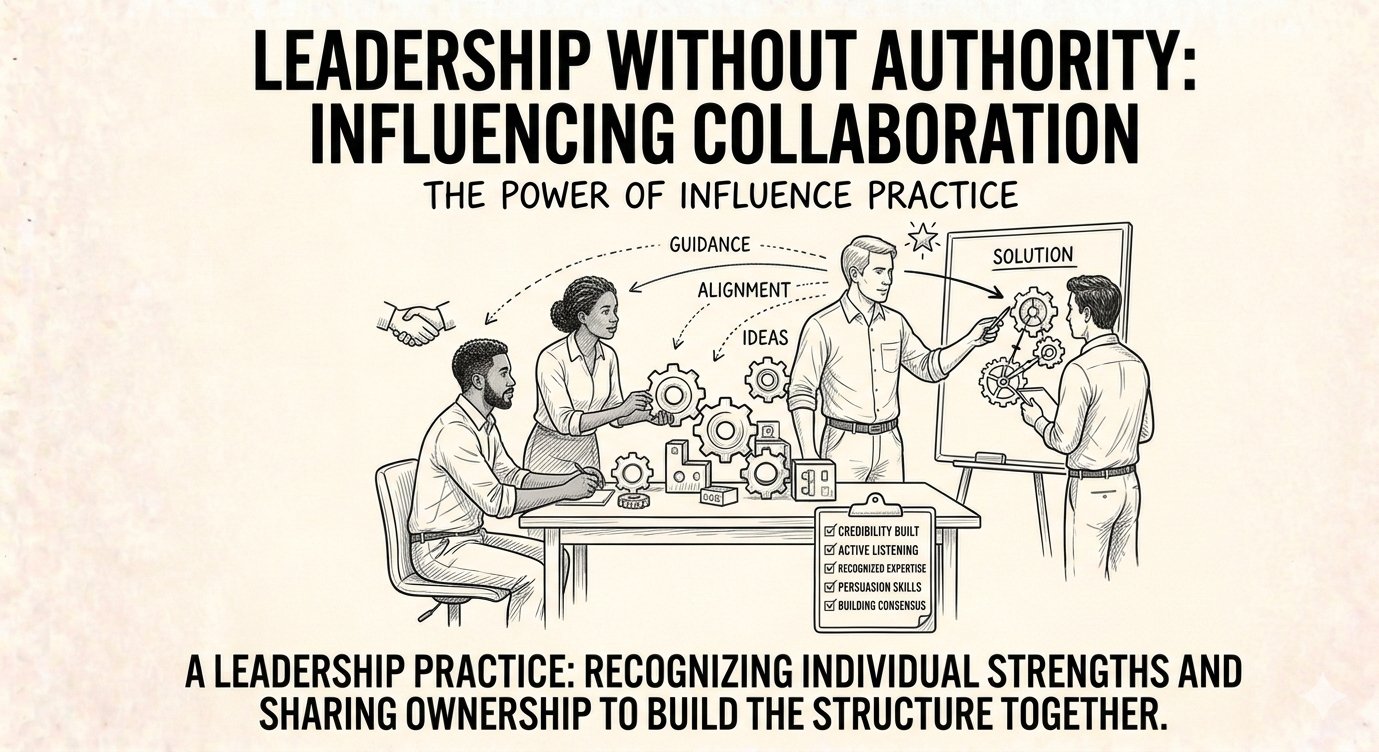
In this blog, I present a short summary from the book " Leading without authority" by Keith Ferrazzi .
We are now in a "Fourth Industrial Revolution" which is so complex and fast-moving that it demands a new type of leadership that empowers all citizens and organizations to innovate, invest and deliver value in a context of mutual accountability and collaboration. For succeeding in this new world, the ability to lead without authority is an essential workplace competency. The author coins a new term called "co-elevation". It is a mission-driven approach to collaborative problem-solving through fluid partnerships and self-organizing teams. When we co-elevate, we enter into close co-creative relationships based on candid feedback and mutual accountability. With this guiding ethos of "going higher together," co-elevation nurtures a generosity of spirit and sense of commitment to our new team mates and our shared mission. The resulting outcomes almost always exceed what could have been accomplished through regular channels within the org chart. Leading without authority through co-elevation requires personal qualities like generosity, gratitude, vulnerability, forgiveness, and celebration. The author talks about a few rules that help in developing co-elevation in the leaders and in the organisation. In this blog, I will explore two of the rules:
1. First rule talks about the composition of the team - Who's your Team? For every project or mission you have, you are responsible for leading a much broader group of people than the formal members of your team.The most critical people to achieve the mission may not necessarily be aligned to your organisation chart. Find someone you think you'll have a positive experience co-elevating with. Choose someone most likely to grasp the roughly outlined vision. Look for those you admire and want to learn from. Look for opportunities to co create a project with this person for the learning experience and to deepen relationships. Identify someone you believe would benefit from your help. Co-elevate this person by coaching him and making a positive difference in that person's career. Face the person or problem that you're avoiding. This person may be at odds and to establish a deeper caring relationship with this formidable colleague may look impossible. But one needs to step up and embrace this person and make him part of the team. Set aside your conviction that your way is the right way. Open yourself to the assumption that others on your team have ideas that may be far better than yours. Prioritise list of your most critical relationships and develop a systematic action plan to nurture them. Improve the relationship continuum from resisting state to coexisting state to collaboration state to co-elevation state. 2. Rule 2 "Accept that it's all on you" : Seize the Responsibility : No matter what your status is within an organisation, the way to be a leader is to start leading. Right Now. Do the job before you have the job.That choice is always entirely in your own hands. And the way to begin is by accepting that it's all on you. Take Charge of your key relationships: We must proactively and authentically develop relationships, keeping in mind the specific tasks we want to achieve in partnership with them. Make yourself vulnerable so that you make yourself approachable. Your goal is to build genuine rapport with him. Avoid excuses like being lazy to invest in building relationships, deferring saying it is beyond your organisation or playing the victim card. You always go first : You owe it to yourself and your organisation to take the first step. Co-elevation does not require consensus of two individuals having to agree. It only requires you taking responsibility to decide to be a co-elevator. Give up being Right: One of the chief obstacles to overcoming resentment is giving up your insistence on being right. We are conditioned to defend our views and positions. But letting someone else to be right is the act of prioritizing your mission over your "rightness". Leadership is everyone's responsibility. You must help lead your team, regardless of your job title or level of authority.
Why This Matters
In an era where competitive advantage increasingly depends on speed, innovation, and adaptability, leaders who rely solely on positional authority will find themselves consistently outmaneuvered by those who can mobilize informal networks and cross-functional collaboration. Organizations that fail to develop co-elevation capabilities will struggle to solve complex problems that span departmental silos, lose top talent who crave more meaningful collaboration, and miss critical market opportunities that require rapid coordination across traditional boundaries. The ability to lead without authority has evolved from a nice-to-have soft skill into a hard business requirement that directly impacts time-to-market, innovation output, and organizational resilience.
Leadership in Practice
When the new CEO became the company's CEO several years ago, he inherited a company plagued by internal competition and siloed thinking. Departments hoarded information, the collaboration platform competed rather than collaborated, and the infamous "stack ranking" system had created a culture where authority and self-preservation trumped collective success. The CEO recognized that the company's survival in the cloud-computing era required a fundamental shift from "know-it-alls" to "learn-it-alls"-but he couldn't simply command this transformation into existence. Instead, the CEO modeled co-elevation principles from the top. He dissolved traditional boundaries by creating cross-functional "One a major technology company" initiatives where engineers, salespeople, and product managers from different divisions worked together on customer solutions without regard to org-chart hierarchies. He personally demonstrated vulnerability by admitting the company's past mistakes and expressing genuine curiosity about ideas from all levels. Most significantly, he empowered the collaboration platform to form fluid partnerships around customer needs rather than waiting for top-down directives. When the cloud platform team needed to integrate with professional social media after the acquisition, they self-organized cross-company the collaboration platform that operated outside traditional reporting structures, united by the mission rather than managed by authority. The results speak volumes: the company's market capitalization grew from approximately $300 billion to over $2 trillion under the CEO's leadership, driven largely by their cloud platform's success-a product that required unprecedented collaboration across previously warring factions. Employee engagement scores rose dramatically, and the company transformed from a company people left to one where talent wanted to stay and contribute. This turnaround wasn't achieved through restructuring or mandate, but through cultivating a culture where people learned to lead without authority and elevate each other toward shared goals.
Leadership Framework
**The Co-Elevation Leadership Framework: Building Influence Beyond Authority**
**Step 1: Map Your Mission Ecosystem**
Before assembling any team, clarity on mission is paramount. Define the specific outcome you're driving toward, then systematically identify every person whose expertise, resources, or influence could materially impact success-regardless of where they sit organizationally. Create a stakeholder map that includes direct reports, peer leaders, subject matter experts, external partners, and even potential skeptics who could derail progress. Critical success factor: Resist the temptation to limit your thinking to "available" resources; instead, identify the right resources.
**Step 2: Cultivate Co-Creative Relationships**
Approach potential team members not with requests for their time, but with invitations to shared purpose. Articulate the mission's significance, why their specific contribution matters, and what success would mean collectively. Practice generous listening to understand their priorities and constraints, then find authentic alignment between the mission and what they care about. Warning: This isn't manipulation; people detect insincerity instantly. Only invite people into missions you genuinely believe will benefit them and advance work they value.
**Step 3: Establish Mutual Accountability**
Co-elevation fails without reciprocal commitment. Create explicit agreements about who will deliver what by when, and build in regular synchronization points for candid feedback. The key difference from traditional accountability: it flows in all directions, not just top-down. As the leader, you must be equally accountable to team members for removing obstacles, providing context, and delivering on your commitments. Critical success factor: Model vulnerability by asking for feedback on your own performance first.
**Step 4: Enable Self-Organization**
Once the mission and accountability structures are clear, resist the urge to dictate how the work gets done. Allow the team to self-organize around the problem, bringing their expertise to bear in ways you couldn't have prescribed. Your role shifts from director to facilitator-asking powerful questions, connecting people with complementary skills, and ensuring information flows freely. Warning: This requires genuine trust and comfort with uncertainty; micromanaging destroys the co-elevation dynamic.
**Step 5: Celebrate and Amplify**
When the team achieves wins-large or small-celebrate them publicly and specifically. Amplify individual contributions, especially from those who lack formal authority or visibility. This isn't just about recognition; it's about reinforcing the behaviors and relationships that made success possible. Share the story of how collaboration created outcomes beyond what any individual could achieve. Critical success factor: Make celebration a discipline, not an afterthought, and ensure credit flows to contributors, not just leaders.
Leadership Takeaway
The most powerful leaders in the Fourth Industrial Revolution will be those who measure their impact not by the size of their team or budget, but by the breadth of their influence and the quality of their co-creative relationships. Starting tomorrow, identify one critical initiative where you've been constrained by thinking within organizational boundaries, then map three people outside your formal authority who could transform the outcome if they fully engaged. Reach out to one of them with a genuine invitation to co-elevate around a shared mission-and watch how influence without authority can accomplish what command and control never could.
"The task of leadership is not to put greatness into people, but to elicit it, for the greatness is there already." — John Buchan
Ramu Kaka's Wisdom
Beta, a true leader is like the sun-it doesn't pull the plants upward by force, but creates the conditions where everything naturally grows toward the light. When you learn to shine on others rather than casting shadows with your authority, you'll be amazed at how high everyone rises together.
Reflection Questions
- When was the last time I achieved a significant outcome by mobilizing people over whom I had no formal authority—and what made them choose to commit their energy to the mission?
- Which critical stakeholders am I excluding from my current initiatives simply because they don't appear on my org chart, and what expertise or influence am I sacrificing as a result?
- How comfortable am I demonstrating vulnerability, asking for help, and accepting feedback from people at all levels—and what might this discomfort be costing my team's performance?
Comments