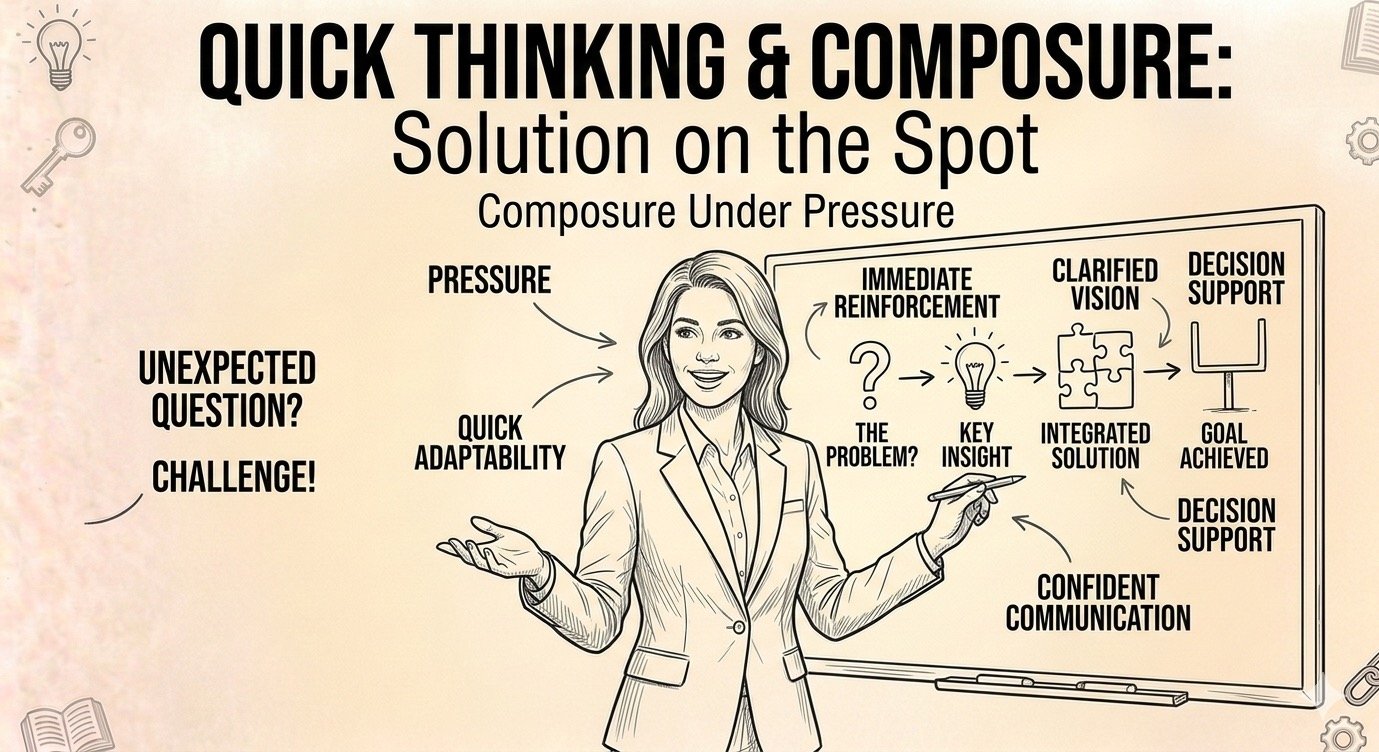
The idea of clear speaking stems from clear thinking. By structuring the ideas into three part plans brings clarity in the communication. It forces you to cut quickly to the core of any subject; it will make you organise your topic into sections that flow logically into one another and it will help you remember your facts and arguments. It will help you stay focused - and concise. By making each part distinct from the other, you ensure that your listeners have digested your first idea before you give them the second. By arranging your ideas into a logical sequence, each idea builds on the previous one, thereby creating a forward moving dynamic that helps persuade your listeners.
Below is the standard format for presenting the ideas with clarity:
1. Introduction : State theme or headline 2. Body : Announce the three main parts of your communication Part I : [Key word] [ content of part 1] Part II : [Key word] [content of part 2] Part III : [Key word] [content of part 3] 3. Conclusion Recap (three main parts of your plan) Echo headline
The training talked about different categories of the plan, but I felt there are three types that are mostly used.
1. Clock Plan : This plan arranges topics in terms of points in time. This plan is very effective in introducing one's career. I used this when I wanted to share my experience. Broke my career into three parts : "First Innings in TI", "Outside TI" and "Second Innings in TI". Then I concisely elaborated each part.
2. Triangle Plan: This plan arranges topics in terms of three aspects. This plan is best used for fairly serious topics, to convey thoughfulness and fair-mindedness to an audience. It communicates your ability to look at all sides of an issue. For example if you are asked what makes one a good development manager .. one can break this topic using triangle plan into three aspects : People, Product Execution & Innovation.
3. Benefits Plan: This plan promotes, sells, convinces and persuades. It rests on what things DO to benefit your listener. If your topic is a product, service, or person, you can create a nice momentum by outlining the benefits in three parts. Focus on how the listener will benefit. For example if you want to promote your product, you can talk about the benefits like Differentiated Cost, Low power, & Ease of use.
By using any one of these plans to structure your body of communication and adhering to the standard format described above, you can bring clarity in your communication.
Why This Matters
Research on communication effectiveness demonstrates that audiences remember structured content far better than unstructured information, and three-part structures specifically outperform both two-part and four-plus-part alternatives in recall and persuasiveness. Yet most professionals never receive systematic training in organizing thoughts rapidly under pressure. They either memorize extensive talking points (which fails when questions deviate from preparation) or wing it (which leads to rambling and lost credibility). The ability to think on your feet using structured frameworks is not a natural talent - it is a learnable skill that directly determines effectiveness in meetings, presentations, and high-stakes conversations where preparation time is limited but performance expectations remain high.
Leadership in Practice
A middle manager at a major technology company attended an unexpected meeting with senior leadership to discuss their team contributions to a critical initiative. The senior vice president asked directly: What value is your team providing to this effort? The manager had not prepared for this question and faced a choice: ramble through disconnected points or apply the three-part framework learned in communication training.
Using the Benefits Plan (which promotes by outlining three ways listeners benefit), the manager structured their response immediately: Our team provides three critical benefits to this initiative: First, Speed - we are accelerating the development timeline by implementing parallel workstreams. Second, Quality - our testing infrastructure catches issues before customer impact. Third, Scalability - the architecture we are building supports ten times current load. Each benefit was elaborated with specific examples, but the three-part structure kept the response focused and memorable.
The SVP later commented that the concise, well-organized answer increased their confidence in the team far more than a rambling enumeration of activities would have. The manager reflected: Without the three-part framework, I would have listed everything we are doing, hoping something sounded impressive. Instead, I cut to three core benefits that matter to leadership. The structure forced clarity in my own thinking, which translated to clarity in communication.
From that experience, the manager made three-part thinking habitual. Meeting preparations began with identifying three key points rather than comprehensive lists. Email communications highlighted three main takeaways. Presentations organized around three supporting pillars. The discipline of thinking in threes transformed communication effectiveness across every context.
Leadership Framework
**The Three-Part Communication Framework**
**Standard Format:**
1. Introduction: State theme or headline that captures core message
2. Body: Announce three main parts, then develop each distinctly
- Part I: [Keyword] [Content]
- Part II: [Keyword] [Content]
- Part III: [Keyword] [Content]
3. Conclusion: Recap three main parts and echo headline
**Plan Types:**
**Clock Plan** - Arranges topics in terms of points in time:
- Use for career narratives, project histories, evolutionary stories
- Example: "My career has three chapters: Early years focused on technical depth, middle period emphasized management skills, current phase combines both in strategic leadership"
**Triangle Plan** - Examines three aspects of a topic:
- Use for analysis, fair-minded exploration, demonstrating thoroughness
- Example: "This technical decision has three aspects to consider: Performance implications, maintenance complexity, and team expertise required"
**Benefits Plan** - Promotes by outlining three ways audience benefits:
- Use for selling ideas, products, or proposals
- Example: "This process change delivers three benefits: Reduced cycle time, improved quality, and better team morale"
**Application Guidelines:**
**Choose Plan Type**: When asked to communicate, first decide which three-part plan fits the situation. Is this a historical narrative (Clock)? An analytical exploration (Triangle)? A persuasive pitch (Benefits)?
**Identify Three Parts**: Force yourself to distill the topic into exactly three main points. Not two, not five. Three. This discipline eliminates peripheral detail and focuses on what truly matters.
**Use Keywords**: Each part should have a memorable keyword or short phrase that anchors more detailed content. Keywords serve as mental bookmarks for both you and your audience.
**Make Parts Distinct**: Ensure each part addresses a different dimension. Overlapping parts confuse rather than clarify. Clear separation helps audience digest each idea before moving to the next.
**Build Logically**: Arrange three parts in sequence that creates momentum. Sometimes chronological order works. Sometimes ascending importance. Sometimes problem-analysis-solution. Choose flow that moves audience naturally from start to conclusion.
**Practice Habitually**: Apply three-part structure to small communications until it becomes automatic. Email summaries. Meeting responses. Casual explanations. Consistent practice builds capability for high-stakes situations.
Leadership Takeaway
This week, practice three-part thinking in every meeting. When answering questions, pause briefly to identify which three-part plan fits, organize your thoughts around three key points, and deliver structured responses. When writing emails, limit yourself to three main points. When preparing presentations, build around three supporting pillars. The discipline of thinking in threes will feel artificial initially but becomes natural with practice. Remember: the goal is not to memorize frameworks but to train your mind to structure thoughts rapidly under any circumstance.
"Simplicity is the ultimate sophistication." - Leonardo da Vinci, capturing how structure creates clarity
Ramu Kaka's Wisdom
The farmer who tries to explain everything about farming will confuse the apprentice. The wise farmer says: Growing crops requires three things - good soil, adequate water, and proper timing. Master these three, and details become clear. So too with communication - master the three-part structure, and clarity follows.
Reflection Questions
- When asked an unexpected question in meetings, do you ramble through disconnected observations or do you have a mental framework for organizing thoughts rapidly?
- How often do you try to communicate everything you know about a topic versus distilling it to three essential points that truly matter?
- If you practiced three-part thinking until it became automatic, how would that change your effectiveness in presentations, meetings, and high-stakes conversations?
Comments