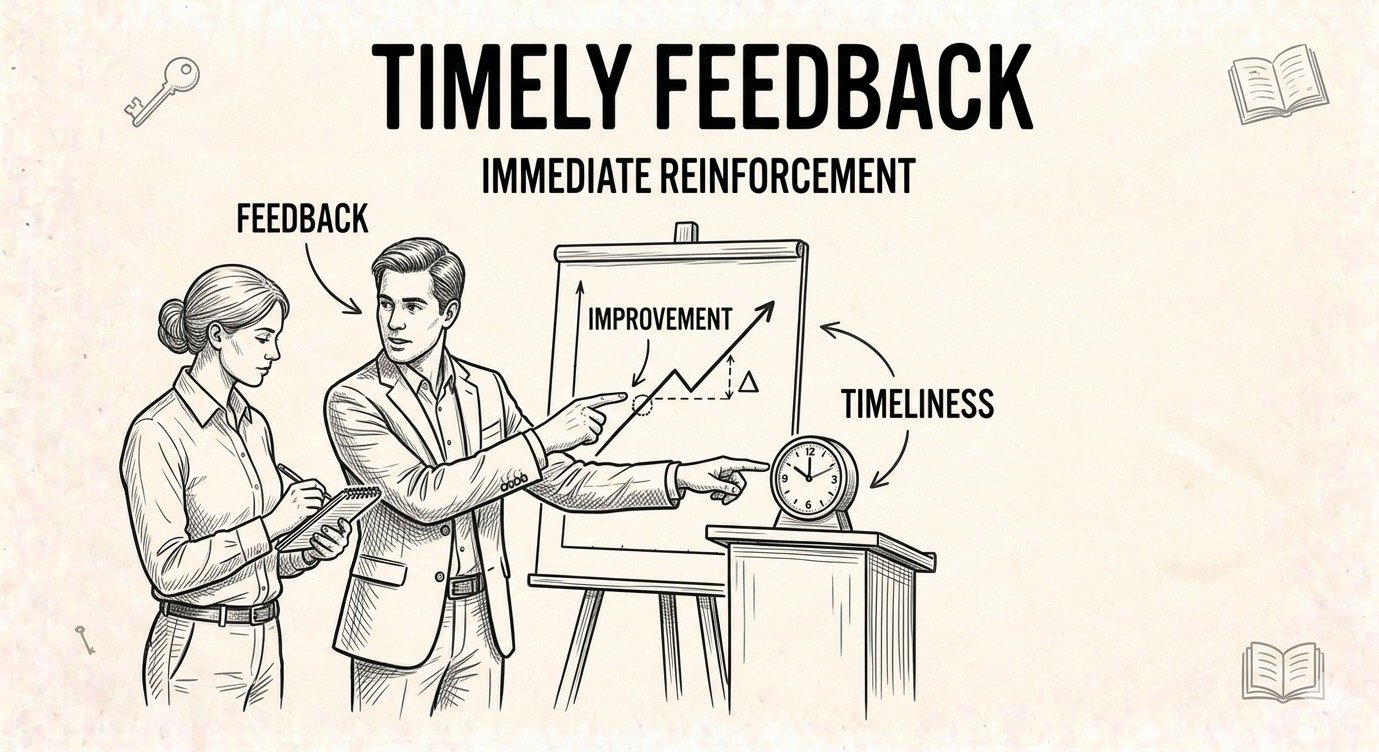
Supervisors are expected to provide feedback to their employees on their performance. There are two aspects to providing feedback - timeliness and being critical. An organisation's performance review process may mandate appraising an employee, say twice a year. But providing feedback to an employee twice a year is not effective. The context settings of the feedback is either lost or forgotten, so the feedback becomes ineffective. Performance improvement is a continuous process and it will be effective only when timely feedback is provided to the employee. The advantage of providing timely feedback is that the context of the feedback is fresh in one's mind. So the feedback will be effective and the supervisor can hold the employee accountable for it. For example, let's say the group's priority is quality of execution, and a bug is found in the design done by an employee. The severity of the bug may be low as the project is yet to be complete, but it provides a golden opportunity for the supervisor to talk to the employee and discuss about it. He can understand the root cause of the issue that led to this bug. If the issue is with the design process, he can act on it immediately. If it is due to over-sight on the employee's part, then it reinforces to the employee that he is falling short of the expectation. This will work in his subconscious mind and he will be more vigilant in the future. If this timely feedback is not provided, then the employee will not feel the pinch of the mistake. Accumulating such feedbacks and providing them at the end of the year will be too late and ineffective.
The second aspect of the feedback is that it should be critical. It should not be sugar coated. If the supervisor rates the employee based on that feedback, then it is unfair to the employee, if he hasn't got the feedback in its true form. Feeling uncomfortable, hesitant or that one will become unpopular cannot be the reasons for the supervisor, not to be critical of his employees. Supervisor who truly cares for his employees will be critical of them. Parents love their children, but that doesn't stop them to be tough with their children, when they make mistakes that is unacceptable. The same relationship holds true between a supervisor/employee in the professional context. Also, the supervisor needs to provide feedforward - set the expectations for the next level, so that the employee knows what he needs to improve to be successful at the next level.
Why This Matters
Organizations invest heavily in formal performance management systems—rating scales, calibration sessions, multi-level approvals—while often ignoring the fundamental requirement that makes feedback work: timeliness. Research consistently shows that delayed feedback has minimal impact on behavior change. By the time annual reviews occur, employees have already internalized their work patterns, both productive and problematic. The manager who waits six months to address a recurring issue has effectively sanctioned that behavior for half a year. Meanwhile, the manager who addresses issues within days creates a culture where standards are real, not theoretical. In fast-moving environments where adaptability matters, the ability to provide immediate, candid feedback isn't just good leadership practice—it's a competitive advantage.
Leadership in Practice
A major streaming company's approach to feedback exemplifies the power of radical timeliness combined with candor. When the company's CEO built the organization's performance culture, he rejected the traditional annual review model entirely. Instead, the company instituted what they called "real-time 360-degree feedback"—a system where feedback isn't saved for scheduled reviews but woven into daily interactions. Managers are explicitly expected to provide candid, immediate feedback, and the culture deck states plainly: "Adequate performance gets a generous severance package."
This might sound harsh, but it's paired with extraordinary transparency and respect. When an engineer ships code with performance issues, their manager addresses it immediately—not in vague terms, but with specific technical discussion. They explore whether it's a skills gap, a process problem, or a misunderstanding of priorities. If it's a skills gap, the company provides training or adjusts responsibilities. If it's consistently inadequate performance despite support, they part ways respectfully with generous severance.
What makes this approach work isn't the threat of termination—it's the predictability and fairness that comes from immediate feedback. No employee is blindsided during a review by accumulated criticisms they never heard. Everyone knows where they stand at all times. When someone receives a generous severance, they're not shocked—they've had multiple candid conversations acknowledging the misalignment. The company maintains one of the highest performance bars in the industry not through fear, but through a culture where feedback flows constantly and honestly. Employees know that silence doesn't mean satisfaction—it means you're not being honest with them.
The result? The company consistently attracts top-tier talent who value clarity over comfort, and maintains industry-leading employee engagement despite—or perhaps because of—its culture of radical candor delivered in real time.
Leadership Framework
**The Timely Feedback System**
Effective performance feedback requires a systematic approach that prioritizes immediacy and honesty. This framework provides practical structure:
**1. The 24-48 Hour Rule**
Address performance issues within 24-48 hours while context remains fresh. When you observe a performance gap—a missed deadline, a quality issue, a problematic interaction—schedule a brief conversation immediately. Don't wait for a "better time" or accumulate multiple issues for efficiency. Each delay reduces the feedback's impact and signals that the standard wasn't really that important.
**2. Context-Rich Conversations**
When providing feedback, reconstruct the specific situation: "In yesterday's code review, the function you submitted had three critical bugs that should have been caught in unit testing." This specificity allows genuine discussion of root causes. Avoid vague generalizations like "your code quality needs improvement" that leave the employee guessing what specifically needs to change.
**3. Root Cause Analysis, Not Blame Assignment**
Move quickly from what happened to why it happened. Ask before telling: "Walk me through your testing process" or "What obstacles did you encounter?" Understanding root causes allows you to distinguish between one-time errors, skills gaps, and systemic issues. The solution for insufficient knowledge (training) differs dramatically from the solution for insufficient attention (reinforcing standards).
**4. Radical Candor Without Cruelty**
Being direct doesn't mean being harsh. State observations factually: "The proposal you submitted didn't include the financial analysis we discussed" rather than "You never listen to requirements." Candor means clarity about standards and gaps, not personal attacks. The goal is to make the issue undeniable while preserving the employee's dignity.
**5. Immediate Course Correction**
Don't just identify problems—establish clear next steps before ending the conversation. "For the next design review, I expect to see unit test results demonstrating you've covered edge cases" gives the employee a specific target. Vague directives like "be more careful next time" don't provide actionable guidance.
**6. Feedforward, Not Just Feedback**
Beyond addressing current performance, set expectations for advancement. "To be ready for a senior role, you'll need to demonstrate the ability to catch these issues in your own work before review" tells the employee what growth looks like. This transforms feedback from criticism into a development roadmap.
**7. Document Immediately**
After delivering feedback, write a brief summary for your records: date, situation, feedback provided, agreed-upon next steps. If the issue recurs, you have clear documentation showing you addressed it immediately rather than letting it slide. This protects both you and the employee from later disputes about whether standards were communicated.
**8. Follow Up to Reinforce**
When the employee corrects the behavior, acknowledge it specifically: "I noticed your last three submissions had comprehensive unit tests—exactly what we discussed." This closes the feedback loop and reinforces that the change mattered. Feedback without follow-up suggests the issue wasn't important enough to track.
**Critical Success Factor**: The effectiveness of feedback is inversely proportional to the time between the event and the conversation. Every day you delay providing feedback is a day the employee continues potentially problematic behavior, believing it's acceptable. The manager who "documents everything for the annual review" isn't being thorough—they're being ineffective. Real-time feedback isn't about catching people doing things wrong; it's about preventing problems from becoming patterns.
Leadership Takeaway
Starting tomorrow, commit to the 24-48 hour rule: when you observe a significant performance gap, schedule the conversation before the day ends. Don't accumulate feedback points for efficiency. Don't wait for the "right moment." The right moment is now, while the context is fresh and the learning potential is highest. Combine this timeliness with genuine candor—not cruelty, but clear, direct communication about standards and gaps. Your team doesn't need you to be comfortable; they need you to be honest. Remember: the leader who delays difficult conversations believing they're being kind is actually being cruel, allowing employees to continue behaviors that will ultimately limit their success. Timely, candid feedback is the foundation of genuine development.
"Feedback is the breakfast of champions." — Ken Blanchard, reminding us that high performers crave timely, honest feedback rather than comfortable silence
Ramu Kaka's Wisdom
The farmer who waits until harvest to tell the farmhand about problems with their planting technique will reap a poor harvest. The wise farmer corrects the technique in the moment, while the soil is still fresh and the lesson can be applied immediately. The same holds true for leaders—feedback given today shapes tomorrow's performance, but feedback delayed until review season merely documents missed opportunities.
Reflection Questions
- How much feedback have you accumulated about your team members that they don't yet know about—and what message does that delay send about whether those issues really mattered?
- When was the last time you delayed a difficult performance conversation because you felt uncomfortable, and how did that delay serve the employee's development?
- If you were brutally honest, what percentage of your feedback is delivered in real-time versus saved for scheduled review sessions—and what would change if you committed to the 24-48 hour rule?
Comments