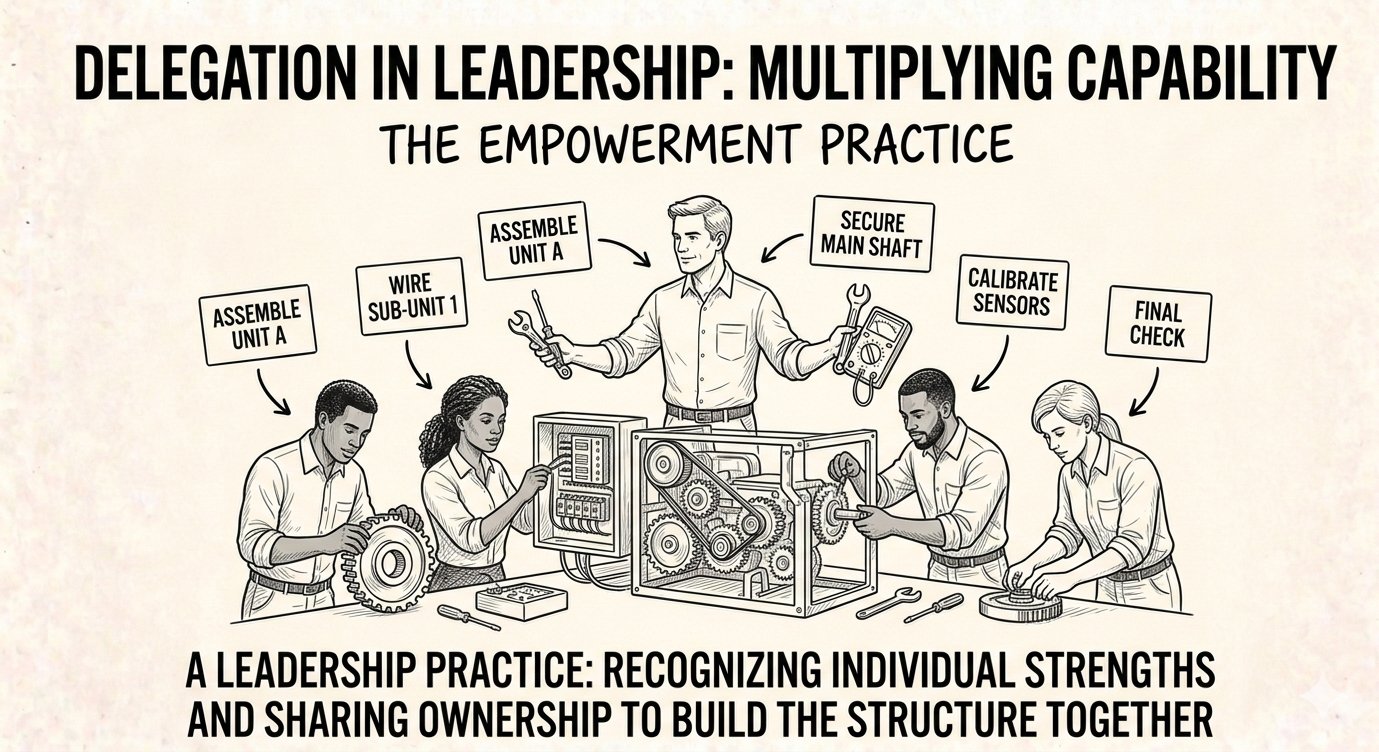
While there are many skills that a good leader should acquire, delegation skill is one of the most important skills. This is the skill that helps create bandwidth for the leader to work on critical and strategic activities. Delegation does not come naturally to many aspiring leaders, as they feel they are losing control, if they have to let go of some of the activities for others to do. The uncertainties of the strategic activities push the leaders to do current urgent activities which are in their comfort zone. This works against delegating the same to others. There is also a fear in delegating the work. What if the person who takes up the delegated work does not do a good job? So what is the effective way to delegate then? From my experience, I share the following :
One needs to categorise his activities into three buckets. I would term them 1) Just Delegate 2) Can Delegate, but monitor 3) Can't Delegate.
Activities under the "Just Delegate" bucket are low risk activities. Even if it is not done well the risk is low. Such activities should be delegated without any hesitation. Filing bugs in the system, documentation of an issue, filling checklists, attending not-so critical meetings, code/design fixes which are not complex etc., could be few examples. Again these activities will differ from one leader to the other. As long as a fail on the delegated task is manageable, then one should not hesitate to delegate.
Activities under the "Can Delegate, but monitor" are those activities that are reasonably critical that if they fail then the effort to recover is more than the effort needed to do it by yourself. These are the activities that I see most leaders hesitant to delegate. But on the other hand these are the activities that are ideal to groom your next level leaders. Challenge the next level leaders with such activities. As the risk to fail is not low, you need to monitor these activities. Also you should not expect them to do those activities exactly as you would do. As long as the end result is correct, you should be willing to accept the different paths that lead to this result. You can review these activities at some regular interval so that they can be corrected if they go off-track. Code reviews, reasonably complex feasibility analysis, debug of an issue etc., could fall in this category.
Activities under the "Can't Delegate" are those activities that are strategic and need more maturity. These are activities that your current role demands and they could also be the activities at the next level (your boss's). Many of these activities are important but not urgent activities. Being good at these activities is critical for your career growth. Networking, cross organisational activities that create visibility, helping your boss on the strategic initiatives, are few examples.
As a leader one needs to create more bandwidth for the last category by doing effective delegation of activities in the first two buckets.
Why This Matters
Leaders who fail to delegate strategically create a triple threat to organizational performance: they bottleneck decision velocity, stunt their team's development, and neglect the strategic thinking their role demands. Companies don't stumble because individual contributors lack skills-they falter when leaders operate as highly-paid individual contributors themselves. The opportunity cost is staggering: every hour a senior leader spends on work others could do represents an hour not spent on competitive positioning, talent development, or innovation that could generate exponential returns. In today's velocity-driven markets, this isn't merely inefficient-it's organizationally negligent.
Leadership in Practice
When the new CEO became the company's CEO several years ago, he inherited a company paralyzed by what insiders called "permission culture"-a systemic failure of delegation where even mid-level decisions escalated to senior executives. Product teams waited weeks for approvals on minor feature changes while executives drowned in operational minutiae. The CEO recognized that the company's innovation deficit wasn't a talent problem; it was a delegation architecture problem. Leaders were trapped in tactical work, leaving no capacity for the strategic reinvention the company desperately needed. The CEO implemented a radical shift in a major technology company's leadership operating model, explicitly redefining what decisions belonged at which levels. He pushed product authority down to engineering the collaboration platform, established clear "escalation criteria" that prevented upward delegation of routine choices, and most importantly, modeled the behavior by publicly stepping back from product details to focus on culture transformation and strategic partnerships. He delegated the "what" while staying intensely involved in the "why" and "who." Engineering leaders suddenly owned their roadmaps with unprecedented autonomy, monitored through quarterly business reviews rather than weekly approval gates. The results were transformative. Their cloud platform's rapid innovation cycle-releasing features at a pace that eventually challenged the company's their cloud services division dominance-stemmed directly from engineering the collaboration platform empowered to make decisions previously reserved for executive review. The company's the company's value increased substantially within five years, driven substantially by products developed under this new delegation architecture. The CEO's focus shifted to what only a CEO could do: repositioning the company's culture from "know-it-all" to "learn-it-all," forging the unexpected partnership with professional social media, and reimagining the company's role in the cloud-first world. The lesson was clear: strategic delegation doesn't just free up executive time-it unlocks organizational velocity and innovation at scale.
Leadership Framework
**THE THREE-TIER DELEGATION FRAMEWORK**
**Tier 1 - Just Delegate (Immediate Transfer Zone)**
- Criteria: Low complexity, low risk, high time consumption
- Examples: Routine documentation, standard reporting, non-critical meeting representation, straightforward bug fixes
- Action: Delegate completely with clear quality standards but minimal oversight
- Success Factor: Document the "how" once, then trust the process
- Warning: If you're still doing these tasks regularly, you're avoiding real leadership work
**Tier 2 - Delegate and Monitor (Leadership Development Zone)**
- Criteria: Moderate complexity, manageable risk, high learning potential
- Examples: Customer presentations, cross-functional projects, technical design decisions, junior team member performance reviews
- Action: Delegate with explicit success criteria, scheduled checkpoints, and coaching support
- Success Factor: Define the outcome, not the method; create space for different approaches
- Warning: Monitoring is not micromanaging-establish checkpoints based on risk level, not anxiety level
- Critical Practice: Conduct a pre-brief (clarify expectations), allow execution autonomy, then hold a post-brief (extract learning)
**Tier 3 - Cannot Delegate (Strategic Leadership Zone)**
- Criteria: Only you have the authority, relationships, or perspective to execute effectively
- Examples: Final strategy decisions, key stakeholder relationships, organizational culture setting, executive team dynamics
- Action: Protect this time fiercely; it's what you're actually paid to do
- Success Factor: If effective delegation in Tiers 1 and 2 isn't creating more Tier 3 time, your categorization is wrong
- Warning: Many leaders avoid Tier 3 work because it's ambiguous and uncomfortable-this is precisely why it's non-delegable
**Implementation Protocol:**
1. Audit your calendar from the past month and categorize every activity into these three tiers
2. Identify your "delegation bottlenecks"-what percentage of time is spent in each tier?
3. Create a 90-day delegation plan moving 80% of Tier 1 and 50% of Tier 2 activities to others
4. Establish a weekly "strategic thinking block" to pressure-test whether you're doing the right work
5. Review quarterly: Are your direct reports taking on bigger challenges? Are you working on increasingly strategic initiatives?
Leadership Takeaway
The delegation paradox is this: the more senior you become, the less your personal productivity matters and the more your team's collective capability determines success. Starting tomorrow, conduct a brutal calendar audit asking one question about each recurring activity: "Am I the only person who could do this, or am I the only person currently doing this?" If it's the latter, you've found your delegation opportunity. Remember, every task you hold onto isn't just work you're doing-it's leadership development you're denying someone else and strategic thinking you're denying your organization.
"The best executive is the one who has sense enough to pick good men to do what he wants done, and self-restraint enough to keep from meddling with them while they do it." — Theodore Roosevelt
Ramu Kaka's Wisdom
A gardener who refuses to let others water the plants while spending all day watering will never have time to plan next season's garden. The plants may survive, but the garden will never flourish. True masters teach others to tend the garden so they can envision the orchard.
Reflection Questions
- What percentage of my time last week was spent on work that someone two levels below me could have done with proper guidance—and what strategic opportunity did I sacrifice as a result?
- Which high-potential team member am I inadvertently limiting by not delegating a challenging assignment that would stretch their capabilities and prepare them for greater responsibility?
- If I'm honest with myself, what non-delegable strategic work am I avoiding by staying busy with tactical activities that feel more comfortable and concrete?
Comments