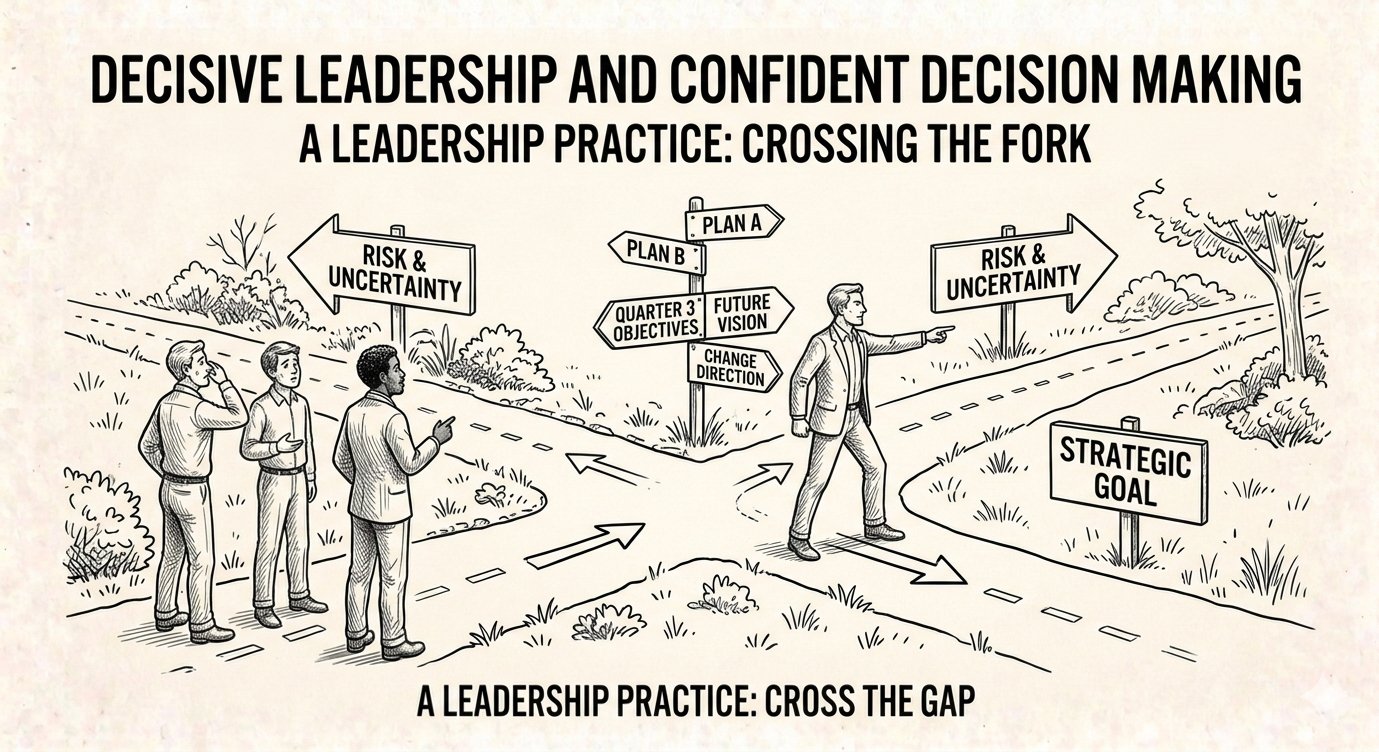
Respect in leadership isn't a title bestowed-it's a reputation built through the quality and courage of your decisions. The most defining characteristic separating exceptional leaders from mediocre managers is their ability to make sound decisions consistently, especially when the path forward remains unclear. Many leaders stumble not from lack of intelligence or experience, but from decision paralysis rooted in fear of being wrong.
Effective decision-making rests on four foundational principles. First, gather essential facts before deciding, but recognize that waiting for perfect information is itself a decision-often the wrong one. When facing incomplete data, ask yourself whether the cost of delay exceeds the risk of acting now. Second, abandon the myth of infallibility. Leaders who aim for perfection make fewer decisions and move slower than competitors. A 60-70% success rate in strategic decisions places you among the top performers; waiting for certainty guarantees irrelevance. Third, understand that difficult decisions often involve choosing between relatively balanced alternatives. In these situations, the velocity of your decision frequently matters more than selecting the theoretically optimal path. Momentum beats perfection.
The fourth principle requires the most courage: decisiveness will sometimes displease people. Give stakeholders a fair hearing, consider diverse perspectives, and weigh the evidence-but when it's time to decide, decide clearly and commit fully. Seeking universal approval is a fool's errand that breeds weak compromises and erodes respect. Your team doesn't need you to make everyone happy; they need you to make the call and provide clear direction.
When facing ambiguous choices, apply these decision filters: Does this action drive progress or enable procrastination? Is it transparent and ethical? Does it align with established precedent, and if not, is the departure justified by compelling circumstances? These questions cut through complexity and illuminate the principled path forward. Leaders who master this discipline don't just make decisions-they build organizational cultures where decisive action becomes the norm, where teams move with confidence, and where respect flows naturally to those who shoulder the burden of choice.
Why This Matters
Indecisive leadership costs organizations far more than occasional wrong decisions. When leaders fail to decide, projects stall, teams lose momentum, top performers grow frustrated, and competitors seize opportunities. Research shows that prolonged decision paralysis erodes team confidence faster than a decisively wrong choice that's quickly corrected. In fast-moving markets, the ability to make timely, well-reasoned decisions with incomplete information isn't just a leadership skill-it's a competitive advantage that determines whether your organization leads or follows.
Leadership in Practice
When the founder and CEO of a leading e-commerce and cloud company decided to launch Web Services (their cloud services division) in the early 2000s, the path was far from clear. The company was primarily an online retailer with no expertise in enterprise cloud computing, and the move would require massive capital investment in infrastructure with uncertain returns. Internal skeptics questioned whether the company should distract itself from its core retail business. The founder didn't have complete information about market demand or competitive response, but he had enough data points: the company had built robust internal infrastructure to handle peak loads, other companies faced similar challenges, and waiting for certainty meant competitors would capture the opportunity. The founder made the call in the mid-2000s to launch their cloud services division publicly, despite incomplete market validation and resistance from those who wanted the company to focus exclusively on retail. The decision wasn't universally popular internally, and it stepped on toes of those invested in the status quo. Yet the founder applied his famous "two-way door" principle-if it failed, the company could retreat. More importantly, he understood that the cost of delayed action exceeded the risk of being wrong. Today, their cloud services division generates over billions of dollars in annual revenue and accounts for the majority of the company's operating profit. The decision that seemed risky in the mid-2000s became obvious in hindsight-but only because the founder had the courage to decide when the outcome remained uncertain. His willingness to make a consequential decision with incomplete information, communicate it clearly, and execute decisively transformed the company from an online bookstore into a technology infrastructure giant.
Leadership Framework
**The RAPID Decision Framework**
Implement this five-element structure to accelerate decision quality and build leadership respect:
**1. Recognize the Decision Type**
Categorize each decision as reversible (two-way door) or irreversible (one-way door). Reversible decisions require 70% confidence and rapid action; irreversible decisions justify deeper analysis but still demand a deadline. Most decisions are more reversible than leaders assume.
**2. Assemble Essential Facts, Not All Facts**
Identify the 3-5 critical data points that genuinely matter, then set a hard deadline for gathering them. Distinguish between information that changes your decision and information that merely confirms what you already know. Stop researching when additional data yields diminishing returns.
**3. Process Diverse Perspectives**
Create explicit space for dissent and alternative viewpoints, but timebox it. Use "disagree and commit" protocols: everyone gets heard, but once decided, everyone aligns. This builds psychological safety while preventing consensus-seeking paralysis.
**4. Implement Decisively With Clear Communication**
Announce decisions unambiguously with supporting rationale, expected outcomes, and success metrics. Assign clear ownership and timelines. Ambiguous decisions create confusion; clear decisions enable execution even when people initially disagreed.
**5. Document and Learn**
Track your decisions and outcomes systematically. Review both successes and failures quarterly to calibrate your judgment. Leaders who learn from their decision patterns improve their accuracy rate significantly over time.
**Critical Success Factor:** The greatest danger isn't making wrong decisions-it's creating a culture where people avoid deciding. Model comfort with uncertainty, reward thoughtful risk-taking even when outcomes disappoint, and address decision paralysis more firmly than decision errors.
Leadership Takeaway
Tomorrow, identify one decision you've been postponing and apply the 70% rule: if you have 70% of the information and reasonable confidence, make the call. Communicate your decision clearly, explain your reasoning, and commit to learning from the outcome regardless of results. Your team will respect the clarity and forward momentum far more than they'll critique an imperfect choice. Leadership authority comes not from always being right, but from consistently having the courage to decide, the wisdom to learn, and the integrity to own the outcomes.
"In any moment of decision, the best thing you can do is the right thing, the next best thing is the wrong thing, and the worst thing you can do is nothing." — Theodore Roosevelt
Ramu Kaka's Wisdom
A captain who cannot choose a direction will never catch favorable winds. Better to sail boldly toward the wrong island and correct course than to drift endlessly in the harbor debating which destination might prove perfect.
Reflection Questions
- What decision have I been avoiding, and what's the real reason—lack of information or fear of being wrong?
- When I look at my last five significant decisions, did I wait too long, decide too quickly, or find the right balance—and what pattern do I notice?
- Do my team members see me as someone who makes clear, timely decisions and owns the outcomes, or as someone who hedges, delays, and shifts responsibility?