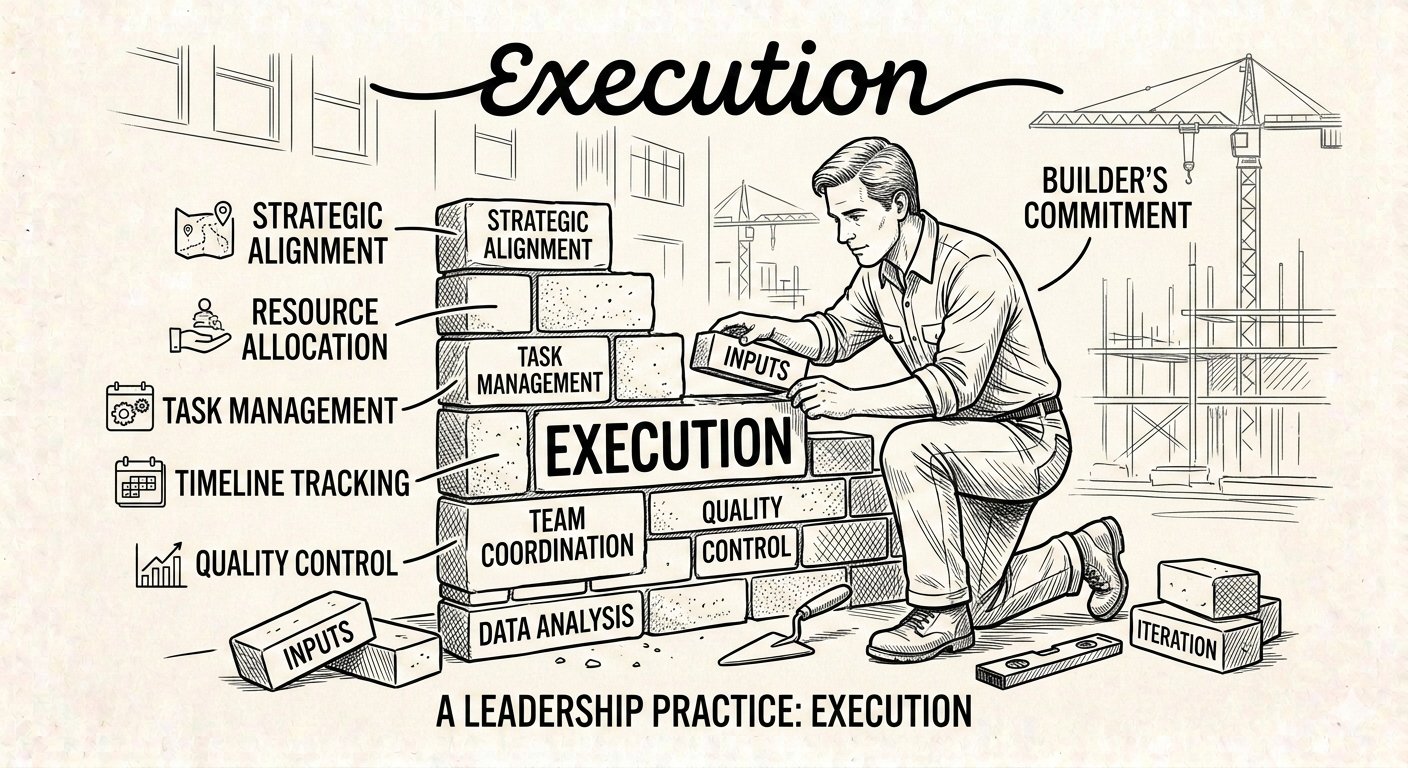
When a colleague recently asked me how to manage schedule slips on aggressive timelines, it sparked a reflection on one of leadership's most critical disciplines: execution under constraint. The question isn't whether deadlines will be imposed-they will. Customer commitments, market windows, and competitive pressures create non-negotiable timelines that test every leader's mettle. The real question is how we architect our approach to maximize success probability while maintaining team sustainability and product integrity.
The foundation of disciplined execution rests on understanding the iron triangle of project management: scope, schedule, and resources. When schedule becomes fixed, leaders must immediately shift to active negotiation mode on the other two dimensions. This isn't capitulation; it's strategic realism. Engage stakeholders early with data-driven scenarios: "With current scope and resources, we have a 30% probability of meeting this deadline. If we descope features X and Y and add three senior engineers, probability rises to 75%." This transparency transforms hope-based planning into risk-informed decision-making. The leaders who fail here are those who accept impossible constraints without negotiating the trade-offs, setting their teams up for burnout and failure.
Even with optimal scope and resourcing, aggressive timelines demand forensic attention to execution mechanics. Analysis of thousands of projects reveals five recurring failure modes: effort underestimation stemming from inadequate task decomposition, decision paralysis at the micro-level, friction in cross-functional handoffs, superficial tracking that misses early warning signals, and teams that comply without committing. Each represents a leadership failure, not a team capability issue. Combat underestimation by mandating day-level task planning-if an engineer cannot articulate what they will accomplish today and tomorrow, the plan is fiction. Require that estimates include not just coding time but specification analysis, architecture review, documentation, peer review cycles, and action item closure. The discipline of granular planning surfaces hidden complexity before it becomes a crisis.
Execution excellence demands that leaders become architects of clarity and velocity simultaneously. Institute daily micro-commitments where each team member declares their specific deliverable for that day. This isn't micromanagement; it's creating a rhythm of accountability that makes slippage visible in hours, not weeks. Empower sub-module leads with genuine decision authority to prevent bottlenecks at the top. Establish friction-free handoff protocols between teams with explicit ownership at every boundary. Most critically, invest time in ensuring every team member internalizes not just their tasks, but why the deadline matters-the customer impact, the market consequence, the strategic imperative. Teams that understand the "why" find creative solutions that teams simply following orders never discover.
The path to execution excellence isn't found in heroic efforts during the final sprint; it's built through disciplined practices applied consistently from day one. Leaders who master this discipline create organizations that don't just meet aggressive deadlines-they build the muscle memory and cultural norms that make sustained high performance possible. This is the difference between one-time success and organizational capability that compounds over time.
Why This Matters
Execution discipline directly impacts revenue, market position, and organizational credibility. When leaders fail to manage aggressive timelines effectively, they don't just miss dates-they erode customer trust, burn out top talent, accumulate technical debt, and cede market opportunities to competitors. In today's velocity-driven markets, the ability to deliver predictably under constraint is not a project management skill; it's a core strategic capability that separates market leaders from followers. Organizations that master execution discipline achieve 3-4x higher on-time delivery rates while maintaining quality and team sustainability.
Leadership in Practice
When a leading e-commerce and cloud company committed to launching Lambda in several years ago, they faced an immovable deadline: the re:Invent conference where they had already scheduled the announcement. The Lambda team, led by a senior VP, inherited an aggressive timeline that couldn't slip without significant business impact. Rather than hoping for the best, the VP immediately applied rigorous scope discipline. He identified the absolute minimum feature set needed for a credible launch-the "minimum lovable product"-and ruthlessly descoped everything else. Features like VPC support and additional language runtimes were deferred to post-launch releases. The team implemented what became known internally as the "daily shipment" model. Every engineer committed to specific daily deliverables in morning standups, and progress was tracked at day-resolution rather than weekly sprints. Cross-functional dependencies between the compute, networking, and billing teams were mapped explicitly with named owners at every handoff point. When technical decisions threatened to create bottlenecks, the VP empowered leads to make final calls within 24 hours rather than escalating for consensus. The result was a successful launch that introduced serverless computing to the market, fundamentally reshaping cloud architecture. Post-launch analysis revealed that the disciplined approach to scope management and daily execution rhythms, not heroic overtime, made the difference. Lambda went on to become one of their cloud services division's fastest-growing services, precisely because the team had built execution muscle memory that enabled rapid iteration post-launch.
Leadership Framework
**The RAPID Execution Framework for Constrained Timelines:**
**1. Reframe the Constraint Triangle (Week 1)**
Immediately upon receiving a fixed deadline, convene stakeholders to explicitly negotiate scope and resources. Present three scenarios with probability assessments: baseline (current state), optimized (with scope reduction), and resourced (with additional capacity). Secure written agreement on which levers are flexible. Critical success factor: Resist the temptation to accept impossible constraints; forced transparency early prevents blame shifting later.
**2. Architect Day-Level Visibility (Ongoing)**
Decompose all work to tasks completable in 1-3 days maximum. If a task cannot be estimated at day resolution, it's insufficiently understood and must be broken down further. Require each engineer to identify their specific deliverable for today and tomorrow in daily standups. Warning: This is not micromanagement if you focus on outcomes, not activities. Track progress daily, not weekly-slippage detected in hours can be corrected; slippage detected in weeks compounds catastrophically.
**3. Pre-wire Decision Velocity (Week 1)**
Map every decision point in the critical path and pre-assign decision makers with explicit authority levels. Establish a decision SLA: technical decisions at task level must resolve within 24 hours, architecture decisions within 48 hours. Create an escalation path with named owners, but measure success by decisions NOT escalated. Empower sub-module leads completely within their domains.
**4. Engineer Frictionless Handoffs (Week 1-2)**
Identify every cross-functional dependency and create explicit interface contracts: what's delivered, in what format, with what acceptance criteria, and who owns verification. Assign a single "handoff owner" for each boundary who is accountable for smooth transitions. Build buffer time specifically for handoff coordination-these transitions consistently consume more time than planned.
**5. Internalize the Mission (Continuous)**
Invest time ensuring every team member understands not just their tasks but the customer impact and business consequence of the deadline. Share customer stories, market data, and strategic context. Teams that know why they're running find energy and creativity that task lists never generate. Hold brief weekly context sessions to maintain this connection as execution pressure builds.
"The way to get started is to quit talking and begin doing... but what separates the successful from the very successful is knowing what to do and what not to do." — Peter Drucker (adapted from Walt Disney and Drucker's principles)