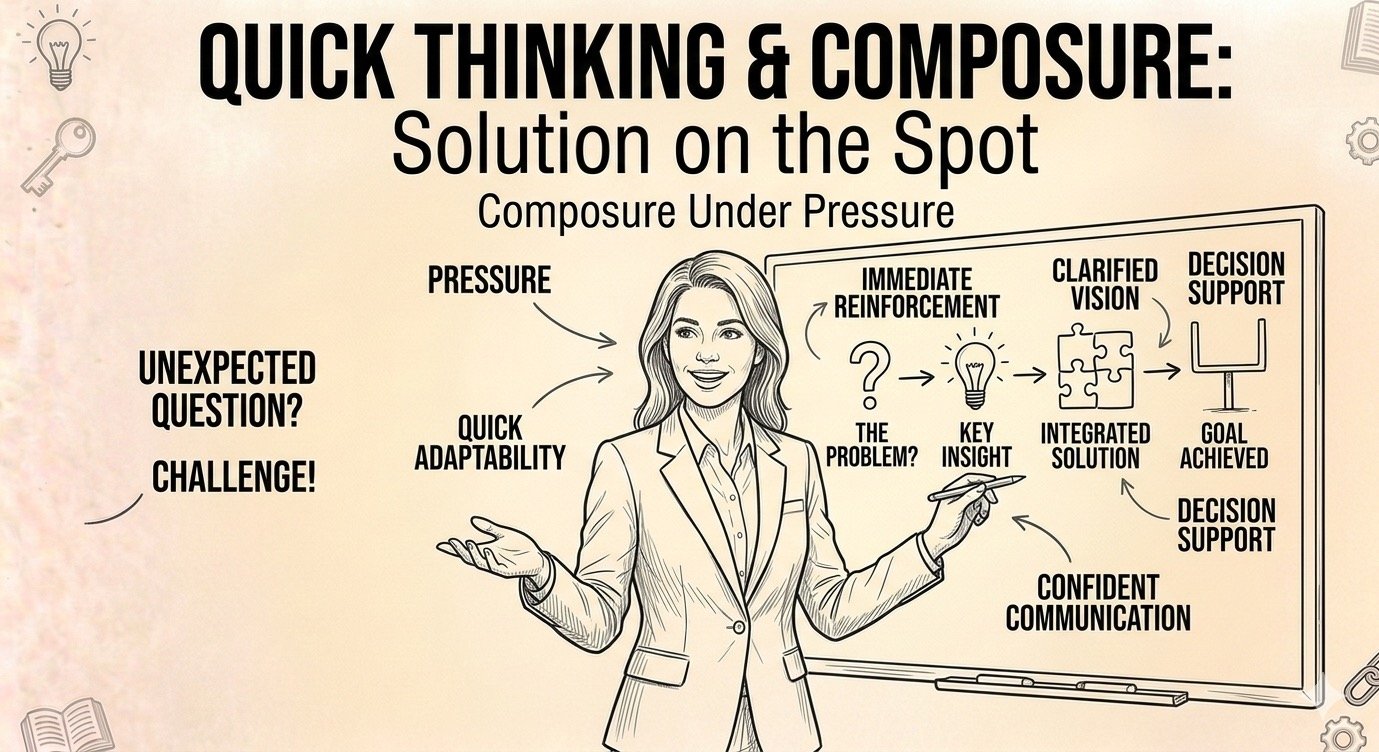
Clear speaking stems from clear thinking, and clear thinking requires structure. When asked to present ideas with limited preparation time - in meetings, during challenging questions, when opportunities arise unexpectedly - most professionals stumble not because they lack knowledge but because they lack a systematic framework for organizing thoughts rapidly. The "Think on Your Feet" method provides exactly that: a structured approach to presenting ideas with clarity, brevity, and impact regardless of preparation time.
The core insight is deceptively simple: structure ideas into three-part plans. This forces you to cut quickly to the core of any subject, organize topics into sections that flow logically into one another, and remember facts and arguments without extensive notes. Three parts create natural rhythm - introduction, development, conclusion. Two parts feel incomplete. Four or more create cognitive overload for listeners still digesting earlier points.
The standard format provides reliability across contexts: Start with a theme or headline that captures your core message. Announce the three main parts of your communication up front, giving listeners a roadmap. Develop each part distinctly with clear transitions, ensuring your audience digests one idea before receiving the next. Conclude by recapping the three main parts and echoing your opening headline. This structure works whether you are answering a question in a meeting, presenting to senior leadership, or organizing a major presentation.
The power lies in how three-part structure shapes thinking, not just communication. When forced to distill complex topics into three key aspects, you identify what truly matters versus peripheral detail. When organizing those three aspects logically, you discover natural connections and flow that make content memorable for both you and your audience. When building each section around a single keyword or phrase, you create mental anchors that eliminate reliance on detailed notes or slides.
Consider the professional asked in a meeting: What makes someone a good development manager? Without structure, most people ramble through disconnected observations, losing both their own train of thought and audience attention. Using the three-part Triangle Plan (which arranges topics in terms of three aspects), the structured response becomes: Good development managers excel in three areas: People - they build and motivate strong teams; Product Execution - they deliver results predictably; and Innovation - they push boundaries rather than maintain status quo. Each keyword anchors detailed elaboration, but the structure remains clear throughout.
The method includes several specific plan types suited to different communication needs. The Clock Plan arranges topics in terms of points in time - ideal for career narratives or project histories. The Triangle Plan examines three aspects of a topic - perfect for analysis and fair-minded exploration. The Benefits Plan promotes and persuades by outlining three ways listeners benefit - essential for selling ideas or products. Each plan type provides ready-made structure adaptable to countless specific situations.
The discipline of thinking in three-part structures becomes habitual with practice. Rather than requiring extensive preparation for every communication, you develop the ability to rapidly organize thoughts using these frameworks. The question becomes not "What do I want to say?" but "Which three-part plan fits this situation?" That single question triggers structured thinking that transforms rambling into clarity.
Why This Matters
Research on communication effectiveness demonstrates that audiences remember structured content far better than unstructured information, and three-part structures specifically outperform both two-part and four-plus-part alternatives in recall and persuasiveness. Yet most professionals never receive systematic training in organizing thoughts rapidly under pressure. They either memorize extensive talking points (which fails when questions deviate from preparation) or wing it (which leads to rambling and lost credibility). The ability to think on your feet using structured frameworks is not a natural talent - it is a learnable skill that directly determines effectiveness in meetings, presentations, and high-stakes conversations where preparation time is limited but performance expectations remain high.
Leadership in Practice
A middle manager at a major technology company attended an unexpected meeting with senior leadership to discuss their team contributions to a critical initiative. The senior vice president asked directly: What value is your team providing to this effort? The manager had not prepared for this question and faced a choice: ramble through disconnected points or apply the three-part framework learned in communication training.
Using the Benefits Plan (which promotes by outlining three ways listeners benefit), the manager structured their response immediately: Our team provides three critical benefits to this initiative: First, Speed - we are accelerating the development timeline by implementing parallel workstreams. Second, Quality - our testing infrastructure catches issues before customer impact. Third, Scalability - the architecture we are building supports ten times current load. Each benefit was elaborated with specific examples, but the three-part structure kept the response focused and memorable.
The SVP later commented that the concise, well-organized answer increased their confidence in the team far more than a rambling enumeration of activities would have. The manager reflected: Without the three-part framework, I would have listed everything we are doing, hoping something sounded impressive. Instead, I cut to three core benefits that matter to leadership. The structure forced clarity in my own thinking, which translated to clarity in communication.
From that experience, the manager made three-part thinking habitual. Meeting preparations began with identifying three key points rather than comprehensive lists. Email communications highlighted three main takeaways. Presentations organized around three supporting pillars. The discipline of thinking in threes transformed communication effectiveness across every context.
Leadership Framework
**The Three-Part Communication Framework**
**Standard Format:**
1. Introduction: State theme or headline that captures core message
2. Body: Announce three main parts, then develop each distinctly
- Part I: [Keyword] [Content]
- Part II: [Keyword] [Content]
- Part III: [Keyword] [Content]
3. Conclusion: Recap three main parts and echo headline
**Plan Types:**
**Clock Plan** - Arranges topics in terms of points in time:
- Use for career narratives, project histories, evolutionary stories
- Example: "My career has three chapters: Early years focused on technical depth, middle period emphasized management skills, current phase combines both in strategic leadership"
**Triangle Plan** - Examines three aspects of a topic:
- Use for analysis, fair-minded exploration, demonstrating thoroughness
- Example: "This technical decision has three aspects to consider: Performance implications, maintenance complexity, and team expertise required"
**Benefits Plan** - Promotes by outlining three ways audience benefits:
- Use for selling ideas, products, or proposals
- Example: "This process change delivers three benefits: Reduced cycle time, improved quality, and better team morale"
**Application Guidelines:**
**Choose Plan Type**: When asked to communicate, first decide which three-part plan fits the situation. Is this a historical narrative (Clock)? An analytical exploration (Triangle)? A persuasive pitch (Benefits)?
**Identify Three Parts**: Force yourself to distill the topic into exactly three main points. Not two, not five. Three. This discipline eliminates peripheral detail and focuses on what truly matters.
**Use Keywords**: Each part should have a memorable keyword or short phrase that anchors more detailed content. Keywords serve as mental bookmarks for both you and your audience.
**Make Parts Distinct**: Ensure each part addresses a different dimension. Overlapping parts confuse rather than clarify. Clear separation helps audience digest each idea before moving to the next.
**Build Logically**: Arrange three parts in sequence that creates momentum. Sometimes chronological order works. Sometimes ascending importance. Sometimes problem-analysis-solution. Choose flow that moves audience naturally from start to conclusion.
**Practice Habitually**: Apply three-part structure to small communications until it becomes automatic. Email summaries. Meeting responses. Casual explanations. Consistent practice builds capability for high-stakes situations.
Leadership Takeaway
This week, practice three-part thinking in every meeting. When answering questions, pause briefly to identify which three-part plan fits, organize your thoughts around three key points, and deliver structured responses. When writing emails, limit yourself to three main points. When preparing presentations, build around three supporting pillars. The discipline of thinking in threes will feel artificial initially but becomes natural with practice. Remember: the goal is not to memorize frameworks but to train your mind to structure thoughts rapidly under any circumstance.
"Simplicity is the ultimate sophistication." - Leonardo da Vinci, capturing how structure creates clarity
Ramu Kaka's Wisdom
The farmer who tries to explain everything about farming will confuse the apprentice. The wise farmer says: Growing crops requires three things - good soil, adequate water, and proper timing. Master these three, and details become clear. So too with communication - master the three-part structure, and clarity follows.
Reflection Questions
- When asked an unexpected question in meetings, do you ramble through disconnected observations or do you have a mental framework for organizing thoughts rapidly?
- How often do you try to communicate everything you know about a topic versus distilling it to three essential points that truly matter?
- If you practiced three-part thinking until it became automatic, how would that change your effectiveness in presentations, meetings, and high-stakes conversations?