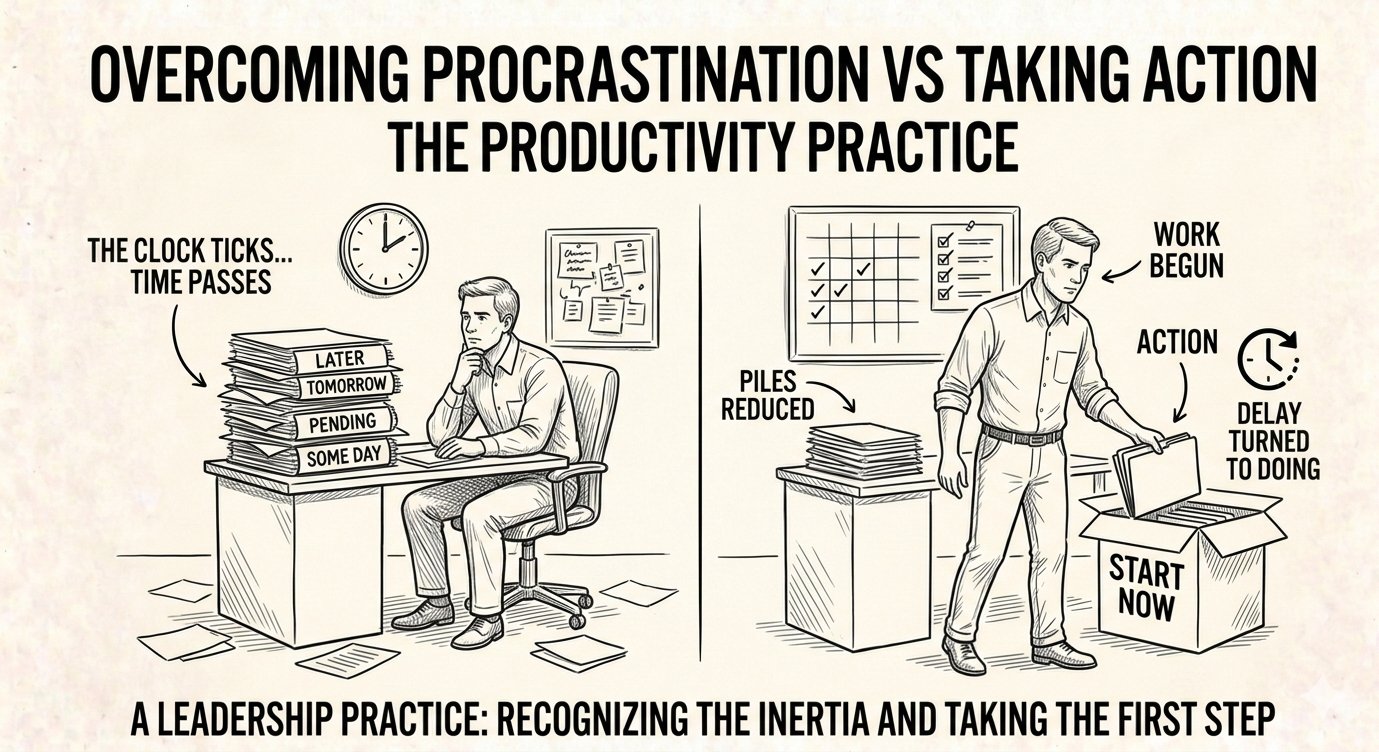
During a time management workshop at my organization, a seemingly simple question emerged: 'How do you overcome procrastination?' This question, ubiquitous yet profound, prompted me to explore beyond conventional wisdom and synthesize research with decades of leadership observation. What I discovered challenges the popular narrative that procrastination is merely a character flaw or discipline problem.
Procrastination is the systematic postponement of decisions or actions despite knowing the consequences. The psychology is straightforward yet nuanced: we rely on self-control to initiate action, supported by motivation that propels us forward. However, demotivating forces-anxiety, fear of failure, perfectionism-create psychological friction. Simultaneously, hindering factors like exhaustion, distant rewards, or abstract goals erode our capacity for action. When these negative forces overpower our motivational reserves, we procrastinate. We delay not until the task disappears, but until the pain of inaction exceeds the pain of action.
Academic literature identifies numerous triggers: abstract goals, delayed gratification, feeling overwhelmed, task aversion, fear of evaluation, perfectionism, and even clinical conditions like ADHD or depression. Yet in my experience leading teams and observing high-performing organizations, I've identified patterns that transcend these academic categories. The most insidious form of procrastination in organizational life isn't the obvious avoidance-it's the 'almost done' syndrome, where critical tasks languish at 95% completion indefinitely.
Consider the uninteresting but essential task-documentation being the quintessential example. Teams enthusiastically execute projects but systematically avoid documenting their work. The innovation happens, the problem gets solved, but the knowledge transfer never occurs. Why? Because the immediate reward (solving the problem) has been captured, while the future reward (organizational learning) feels abstract and distant. The solution isn't motivational speeches about documentation's importance; it's restructuring the work itself. I've found success by integrating documentation into the definition of 'done,' assigning it to team members who find systematic thinking energizing, or gamifying the process with immediate recognition. One team I worked with implemented 'Documentation Fridays' where the entire group collaboratively captured the week's learnings-transforming a solitary, boring task into a social, reflective practice that people actually anticipated.
The deeper insight here is that overcoming procrastination isn't about willpower-it's about understanding the specific friction points in your workflow and systematically engineering them out. Leaders who grasp this distinction transform not just individual productivity, but organizational velocity. They recognize that 'almost done' is the most expensive phrase in business, representing sunk costs without realized value, and they build systems that pull work across the finish line rather than relying on heroic individual effort.
Why This Matters
Organizational procrastination costs more than individual productivity-it destroys compounding value. When strategic initiatives stall at 95%, when documentation remains incomplete, when decisions get postponed 'until we have more data,' companies forfeit their competitive advantage to more decisive competitors. Leaders who dismiss procrastination as a personal discipline issue miss the systemic dysfunction it signals: misaligned incentives, abstract goals, or overwhelming complexity. In high-velocity markets, the cost of 'almost done' isn't just the delayed project-it's the market opportunity that closes, the talent that disengages, and the organizational learning that never compounds.
Leadership in Practice
Pixar Animation Studios faced an existential procrastination problem during the production of Toy Story 2. Initially planned as a direct-to-video release, the project suffered from perpetual incompleteness-scenes were 'almost done,' character development was 'nearly there,' and story arcs remained 'just about finished.' When John Lasseter screened the 90% complete film, he made a career-defining decision: scrap nearly everything and start over, despite having only nine months until the deadline. The team wasn't lazy; they were trapped in the 'almost done' purgatory where nothing felt quite finished enough to ship. Lasseter's insight was that the procrastination wasn't about effort-it was about unclear standards and abstract goals. He implemented what Pixar now calls the 'Braintrust'-a framework where specific, concrete feedback replaced vague dissatisfaction. Instead of 'this scene doesn't work,' the feedback became 'Woody's motivation in minute 37 contradicts his character arc from minute 12.' This specificity transformed abstract anxiety into concrete action items. The result? Toy Story 2 became both a critical and commercial triumph, grossing nearly $500 million and establishing the creative methodology that would produce Pixar's unprecedented string of successes. The lesson wasn't about working harder-it was about making 'done' a concrete, achievable state rather than an ever-receding mirage.
Leadership Framework
**The Procrastination-Proof Execution Framework**
**Step 1: Make 'Done' Concrete and Visible**
Replace abstract completion criteria with specific, observable outcomes. Instead of 'improve customer satisfaction,' define it as 'reduce support ticket resolution time to under 4 hours for 95% of tickets.' Ambiguity breeds procrastination; specificity generates momentum. Create visual progress indicators that make 95% completion as uncomfortable as 0%.
**Step 2: Identify the Hidden Friction**
Conduct 'procrastination autopsies' on stalled initiatives. Ask: Is the task uninteresting? Are rewards too distant? Is perfectionism masquerading as quality? Is the task assigned to someone who finds it energy-draining rather than energizing? Most procrastination isn't motivational-it's operational. Map the specific barrier, then engineer around it.
**Step 3: Restructure Incentives for Completion, Not Just Initiation**
Organizations celebrate project launches but rarely completion. Reverse this. Implement 'closure bonuses' where the final 10% of a project receives disproportionate recognition. One executive team I advised created a 'Done Wall' where only 100% complete initiatives earned space-no partial credit. This simple visibility shift reduced their portfolio of stalled projects by 60% in one quarter.
**Step 4: Match Tasks to Energy Profiles**
Not all procrastination is equal. Documentation drains some people while energizing others. Assign uninteresting-but-essential tasks to team members whose cognitive preferences align with them, or create rotation systems that prevent burnout. When task assignment considers energy profiles, procrastination decreases organically.
**Step 5: Build 'Forcing Functions' Into Your Workflow**
Create artificial constraints that make procrastination impossible. Public commitments, staged deadlines with real consequences, and 'definition of done' gates in your project management system transform optional completion into structural necessity. The key is making these forcing functions legitimate constraints, not bureaucratic theater.
**Critical Success Factor:** This framework fails if leaders treat procrastination as a character issue requiring discipline rather than a systems issue requiring redesign. The moment you blame individuals for procrastination, you've lost the ability to fix the underlying workflow dysfunction.
"The secret of getting ahead is getting started. The secret of getting started is breaking your complex overwhelming tasks into small manageable tasks, and then starting on the first one." — Mark Twain