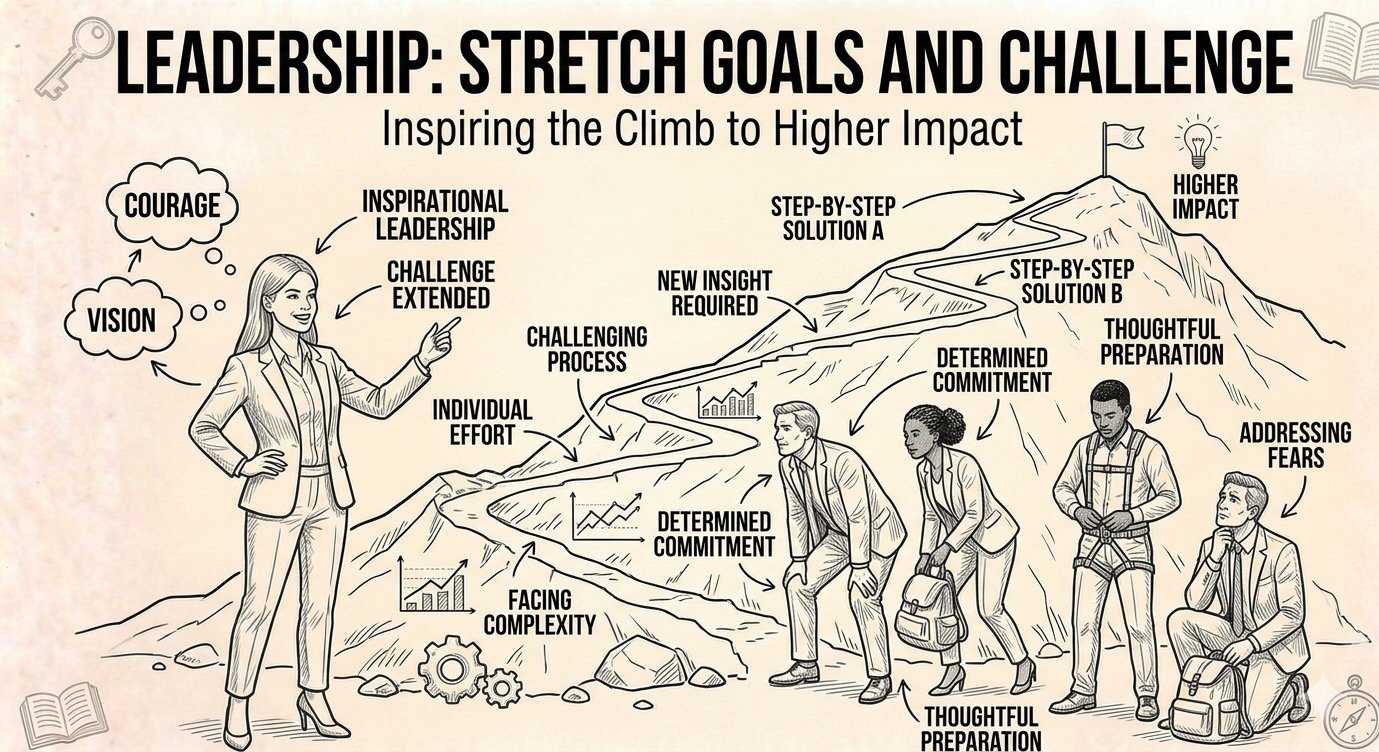
As a middle manager, you often receive feedback from senior leadership that you are not challenging your team enough to achieve ambitious goals. You are closer to your team than your manager, giving you intimate knowledge of their capacity and constraints. This creates a leadership dilemma: you want to be seen as someone who pushes for excellence, yet you do not want to appear unreasonable or out of touch with ground realities.
This catch-22 situation is common in organizations. How should you navigate it effectively?
**Challenge Assumptions, Not Commitment**
When your team estimates a task will take four weeks, simply demanding they complete it in two or three weeks accomplishes nothing positive. This approach signals distrust in their judgment and undermines credibility.
The superior strategy is to challenge the underlying assumptions that led to their estimate. Go several levels deeper in your assessment. Perhaps the sequencing of tasks could be optimized. Maybe the scope could be refined. Could different resources be assigned? Should other project commitments be reprioritized? Would additional support accelerate progress?
As a leader, question assumptions recursively until you have exhausted all options. This demonstrates respect for their expertise while pushing for optimal solutions.
**Challenge the Norm and Status Quo**
Teams often default to established patterns with the justification "this is the way it has always been done." Repeating the same approach while expecting different results is the definition of futility.
Consider a recent example: a quality team required 4,000 hours of qualification for a chip because certain components lacked prior qualification. When challenged, the team engaged with the process group to explore alternatives. By conducting specific component simulations, they reduced the qualification requirement significantly without compromising quality standards.
Had the challenge not been issued, the team would have blindly followed standard procedures, severely impacting the product schedule. Effective leaders question established norms when circumstances warrant fresh thinking.
**Create "Push to the Corner" Situations**
When people operate in comfort zones, they are not challenged sufficiently. By creating situations where comfort zones are disrupted, you force creative problem-solving and out-of-the-box thinking.
In one project with an aggressive schedule, a new design task arose that did not require highly experienced resources. Under normal circumstances, this would be assigned to a junior engineer to avoid challenging senior team members' egos. However, the schedule pressure demanded optimal resource allocation.
The task was assigned to a senior engineer, which proved to be the right strategy. The engineer's professionalism and the project's urgency aligned to produce excellent results. The "corner" situation enabled a decision that would not have been made in a comfort zone environment.
These three techniques - challenging assumptions, questioning norms, and creating constructive pressure - allow you to push your team toward higher performance without becoming the unreasonable leader everyone resents. The goal is not to add pressure for pressure's sake, but to unlock potential that conventional thinking leaves untapped.
Leadership in Practice
A leading e-commerce and cloud company's famous 'two-pizza team' structure emerged from the founder and CEO challenging a fundamental assumption about how software development scaled. In the early 2000s, the company's growth was slowing as teams expanded and communication overhead exploded. The conventional wisdom suggested that bigger, more complex challenges required proportionally larger teams. The founder questioned this assumption relentlessly, asking why coordination costs had to increase exponentially with team size. His team discovered that small, autonomous teams with clear ownership could actually move faster on complex problems than large, coordinated groups. This insight led to a complete restructuring of the company's engineering organization around small, independent teams-each small enough to be fed with two pizzas. But the breakthrough wasn't just about team size; it was about challenging the assumptions around dependencies, communication protocols, and decision rights. By questioning why teams needed extensive coordination, the company identified architectural changes (service-oriented architecture, API-first design) that enabled true autonomy. The result wasn't just faster delivery; it was a competitive advantage that powered the company's expansion from e-commerce into their cloud services division, devices, media, and beyond. This transformation didn't happen by telling teams to 'work harder'-it happened by systematically challenging the assumptions that made their work difficult.
Leadership Framework
**The Assumption Excavation Framework**
**Step 1: Separate Commitment from Constraints**
When receiving an estimate or assessment, explicitly acknowledge the team's expertise and effort before exploring assumptions. Begin with: 'I trust your judgment and commitment. Help me understand the constraints you're working within.' This framing establishes psychological safety for the exploration ahead.
**Step 2: Map the Assumption Layers**
Systematically identify assumptions at multiple levels:
- Scope assumptions: What must be included versus what could be phased?
- Sequence assumptions: What dependencies are technical versus conventional?
- Resource assumptions: What skills are truly required versus traditionally assigned?
- Quality assumptions: What standards are regulatory versus preferential?
- Process assumptions: What steps are value-adding versus inherited practice?
**Step 3: Test Each Assumption with 'What Would Have to Be True?'**
For each assumption, ask: 'What would have to be true to do this differently?' This question shifts from defending the status quo to exploring possibilities. Document which assumptions are immovable constraints versus challengeable conventions.
**Step 4: Co-Create Alternative Scenarios**
With assumptions exposed, collaborate on alternatives: 'If we reduced scope by X, how does that change the timeline? If we sequenced differently, what becomes possible?' Generate multiple scenarios rather than forcing a single 'stretch goal.'
**Step 5: Commit with Transparency**
Choose a path forward with clear visibility into which assumptions you're changing and what risks you're accepting. Document learning for future estimates.
**Critical Success Factor**: This framework fails if used manipulatively to get predetermined answers. It succeeds when leaders genuinely seek understanding and accept that some constraints are real. **Warning**: Never use this approach in crisis mode when time pressure prevents proper analysis-that erodes trust in the method.
"The quality of a leader is reflected in the standards they set for themselves." - Ray Kroc