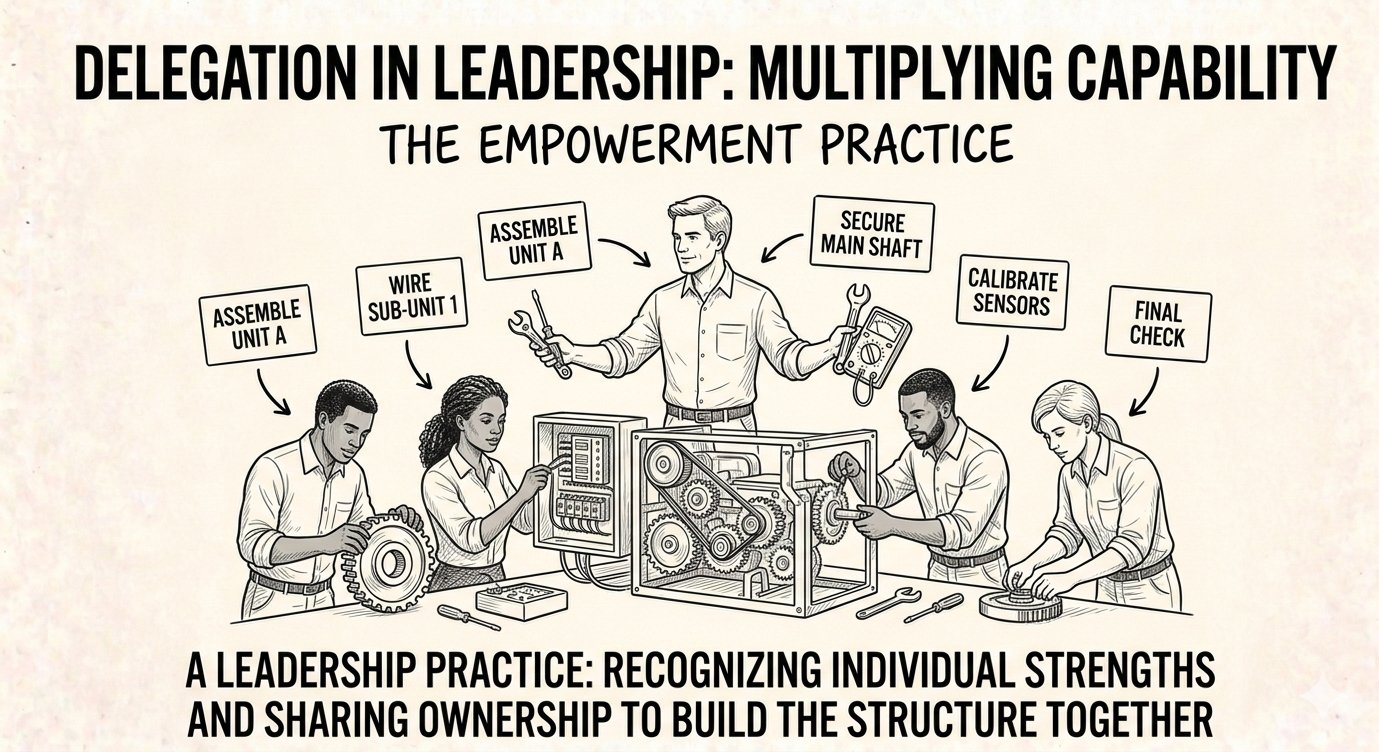
Delegation remains one of leadership's most misunderstood competencies. Many leaders intellectually grasp its importance yet struggle to practice it effectively, trapped by the paradox that the activities consuming their time are often the very ones they should be transferring to others. The root cause isn't lack of knowledge-it's fear. Fear of loss of control, fear of failure by proxy, and perhaps most insidiously, fear of facing the ambiguous strategic work that only they can do.
The solution lies in strategic categorization. Effective leaders segment their responsibilities into three distinct tiers: "Just Delegate," "Delegate and Monitor," and "Cannot Delegate." The first tier-low-risk, low-complexity tasks like routine documentation, standard bug logging, or non-critical meeting attendance-should be handed off immediately and completely. These are leadership table stakes; holding onto them signals either insecurity or poor time judgment. The real leadership testing ground exists in the second tier: moderately complex, moderately risky activities where failure carries consequences but not catastrophic ones. This is where leader development happens.
This middle tier represents your organization's leadership development laboratory. When you delegate a challenging customer presentation, a cross-functional negotiation, or a technical architecture decision to a high-potential team member, you're not simply offloading work-you're creating what organizational psychologists call "stretch assignments." These experiences, where the difficulty level slightly exceeds current capability, generate the most powerful professional growth. The critical requirement? Active monitoring without micromanaging. Establish clear checkpoints, define success criteria explicitly, and create psychological safety for course correction. Your role shifts from doer to coach, from executor to capability builder.
The third tier-truly non-delegable responsibilities like final accountability for strategic decisions, key stakeholder relationships, and organizational culture setting-should consume the bandwidth you've created through effective delegation. Yet here's the paradox: leaders often cling to tier-one and tier-two work to avoid tier-three responsibilities. Strategic thinking is harder than tactical execution. Building a three-year product roadmap feels more ambiguous than reviewing code. Having difficult conversations about performance requires more emotional labor than attending meetings. Delegation isn't just about distributing work; it's about forcing yourself into the leadership work only you can perform.
The ultimate measure of delegation effectiveness isn't how much you've offloaded-it's whether you're now spending your time on activities that would fail or flounder without your specific expertise, relationships, and authority. If your calendar could be replicated by someone two levels below you, you're not leading; you're just busy. Master delegation not to work less, but to work on what matters most: building strategy, developing people, and creating the conditions for your organization to thrive beyond your direct involvement.
Leadership in Practice
When the new CEO became the company's CEO several years ago, he inherited a company paralyzed by what insiders called "permission culture"-a systemic failure of delegation where even mid-level decisions escalated to senior executives. Product teams waited weeks for approvals on minor feature changes while executives drowned in operational minutiae. The CEO recognized that the company's innovation deficit wasn't a talent problem; it was a delegation architecture problem. Leaders were trapped in tactical work, leaving no capacity for the strategic reinvention the company desperately needed. The CEO implemented a radical shift in a major technology company's leadership operating model, explicitly redefining what decisions belonged at which levels. He pushed product authority down to engineering the collaboration platform, established clear "escalation criteria" that prevented upward delegation of routine choices, and most importantly, modeled the behavior by publicly stepping back from product details to focus on culture transformation and strategic partnerships. He delegated the "what" while staying intensely involved in the "why" and "who." Engineering leaders suddenly owned their roadmaps with unprecedented autonomy, monitored through quarterly business reviews rather than weekly approval gates. The results were transformative. Their cloud platform's rapid innovation cycle-releasing features at a pace that eventually challenged the company's their cloud services division dominance-stemmed directly from engineering the collaboration platform empowered to make decisions previously reserved for executive review. The company's the company's value increased substantially within five years, driven substantially by products developed under this new delegation architecture. The CEO's focus shifted to what only a CEO could do: repositioning the company's culture from "know-it-all" to "learn-it-all," forging the unexpected partnership with professional social media, and reimagining the company's role in the cloud-first world. The lesson was clear: strategic delegation doesn't just free up executive time-it unlocks organizational velocity and innovation at scale.
Leadership Framework
**THE THREE-TIER DELEGATION FRAMEWORK**
**Tier 1 - Just Delegate (Immediate Transfer Zone)**
- Criteria: Low complexity, low risk, high time consumption
- Examples: Routine documentation, standard reporting, non-critical meeting representation, straightforward bug fixes
- Action: Delegate completely with clear quality standards but minimal oversight
- Success Factor: Document the "how" once, then trust the process
- Warning: If you're still doing these tasks regularly, you're avoiding real leadership work
**Tier 2 - Delegate and Monitor (Leadership Development Zone)**
- Criteria: Moderate complexity, manageable risk, high learning potential
- Examples: Customer presentations, cross-functional projects, technical design decisions, junior team member performance reviews
- Action: Delegate with explicit success criteria, scheduled checkpoints, and coaching support
- Success Factor: Define the outcome, not the method; create space for different approaches
- Warning: Monitoring is not micromanaging-establish checkpoints based on risk level, not anxiety level
- Critical Practice: Conduct a pre-brief (clarify expectations), allow execution autonomy, then hold a post-brief (extract learning)
**Tier 3 - Cannot Delegate (Strategic Leadership Zone)**
- Criteria: Only you have the authority, relationships, or perspective to execute effectively
- Examples: Final strategy decisions, key stakeholder relationships, organizational culture setting, executive team dynamics
- Action: Protect this time fiercely; it's what you're actually paid to do
- Success Factor: If effective delegation in Tiers 1 and 2 isn't creating more Tier 3 time, your categorization is wrong
- Warning: Many leaders avoid Tier 3 work because it's ambiguous and uncomfortable-this is precisely why it's non-delegable
**Implementation Protocol:**
1. Audit your calendar from the past month and categorize every activity into these three tiers
2. Identify your "delegation bottlenecks"-what percentage of time is spent in each tier?
3. Create a 90-day delegation plan moving 80% of Tier 1 and 50% of Tier 2 activities to others
4. Establish a weekly "strategic thinking block" to pressure-test whether you're doing the right work
5. Review quarterly: Are your direct reports taking on bigger challenges? Are you working on increasingly strategic initiatives?
"The best executive is the one who has sense enough to pick good men to do what he wants done, and self-restraint enough to keep from meddling with them while they do it." — Theodore Roosevelt