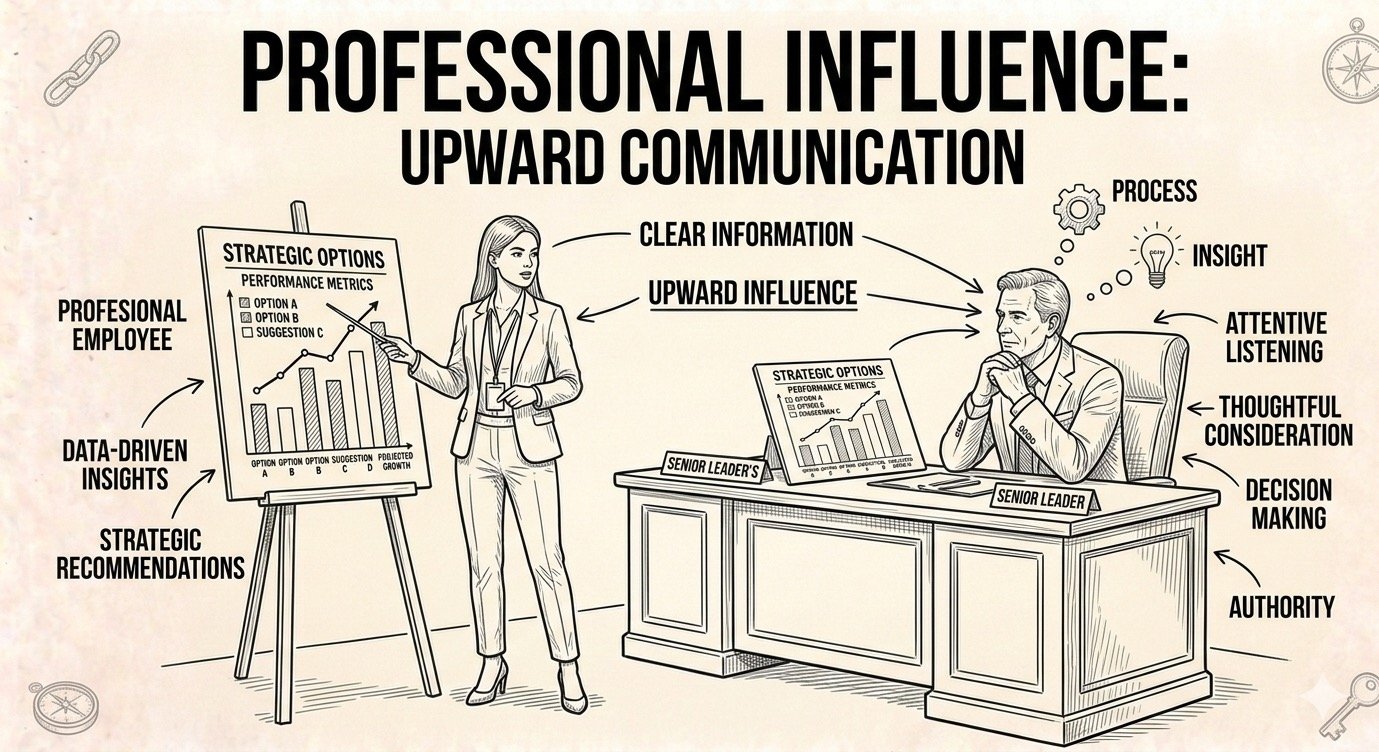
Middle managers walk a perpetual tightrope, balancing aggressive expectations from senior leadership against realistic assessments of team capacity and constraints. Push back too forcefully on unrealistic goals, and you risk appearing defensive or uncommitted. Advocate too strongly for your team's limitations, and you might be labeled a union leader rather than a results-oriented manager. This tension defines middle management, yet few receive systematic training in the art of managing upward—the strategic skill of maintaining productive relationships with senior leaders while delivering results through your team.
The fundamental insight is this: senior leaders don't need defenders of the status quo. They need leaders who accept challenging goals while providing honest assessments of obstacles, resource needs, and risks. The difference between excuse-making and strategic partnership lies in how you frame constraints—not as reasons something cannot be done, but as variables requiring attention in execution plans.
Consider the manager facing an externally imposed deadline—a customer commitment, a market window, an organizational metric. The natural instinct is to explain why the timeline is unrealistic: insufficient resources, technical complexity, competing priorities. But senior leadership already knows it is difficult. That is precisely why they need leadership. Your job is not to explain why it is hard. Your job is to propose how it might be accomplished and what support you need to make it happen.
This requires a fundamental mindset shift. The goal cannot be compromised—that is the starting assumption, not the subject of negotiation. Your responsibility is to work backward from that fixed endpoint, identifying what must be true for success to be possible: scope adjustments, resource additions, priority shifts, risk acceptances. These become your options to present, not excuses for why the goal cannot be met. When you approach senior leadership with options rather than obstacles, you signal that you have accepted ownership of the challenge rather than simply cataloging its difficulty.
Effective upward management requires three strategic capabilities: providing options rather than excuses, managing senior leader expectations through constant communication, and motivating your team to pursue goals they perceive as aggressive. These three capabilities form an integrated system. You cannot deliver on aggressive commitments without team buy-in. You cannot maintain team motivation without senior leader understanding of constraints. You cannot provide strategic options without understanding both team capabilities and leadership priorities.
Why This Matters
Research across industries demonstrates that middle managers with strong upward management skills receive more resources, enjoy greater autonomy, and advance faster than peers who view senior leadership as adversaries rather than partners. Yet most managers never receive training in this critical competency, learning through painful trial and error—or never learning at all. The ability to translate senior leadership direction into team motivation while managing senior leader expectations through strategic communication is not a personality trait; it is a learnable skill set that directly determines whether you become a trusted partner invited into strategic discussions or an execution bottleneck working from directives. In an era where organizational hierarchies flatten and influence matters as much as authority, managing upward effectively determines access to resources, opportunities, and career advancement.
Leadership in Practice
A development manager at a major technology company received an aggressive product deadline driven by a customer commitment that leadership had already communicated externally. The timeline was eighteen months for work the team estimated at twenty-four months minimum. The manager's initial instinct was to push back hard, providing detailed technical analysis demonstrating the timeline was unrealistic.
But before that meeting, a mentor advised: "Leadership doesn't need you to tell them it's hard. They need you to tell them how it might be possible." The manager restructured the conversation entirely. Rather than defending the twenty-four month estimate, they presented three options: deliver reduced scope in eighteen months with specific feature deferrals clearly articulated; deliver full scope in twenty-one months with additional headcount and consulting services; or pursue an accelerated development approach with higher technical risk but potential to meet the eighteen-month target.
Leadership appreciated the options-oriented approach and authorized additional resources while accepting slightly reduced scope for the initial release. More importantly, the manager established credibility as a problem-solver rather than an obstacle. Over subsequent projects, this manager was consistently given more challenging assignments and greater autonomy because leadership trusted them to find solutions rather than simply surface problems.
The lesson: managing upward is not about managing down expectations. It is about managing up solutions while being honest about constraints and required support.
Leadership Framework
**The Strategic Upward Management Framework**
**1. Provide Options, Not Excuses**
When facing aggressive goals, shift immediately from why it is hard to how it might be accomplished: Assume the goal is fixed and work backward to identify what must change to make it achievable. Present multiple options with different trade-offs: scope reductions, resource additions, risk acceptances, timeline extensions. Frame each option's implications clearly so leadership can make informed decisions. Never present a single path or simply explain why something cannot be done.
**2. Internalize and Communicate the Vision**
Before presenting obstacles to your team, ensure you have genuinely bought into the goal's strategic importance: Understand why leadership views this as critical for the organization. Articulate that importance to yourself until you believe it. When communicating to your team, lead with vision before discussing challenges. If you frame the goal as unreasonable, your team will follow that interpretation. If you frame it as difficult but critical, they will rise to meet it.
**3. Constant Communication with Senior Leaders**
Senior leaders despise surprises, particularly bad ones: Establish regular touchpoints beyond formal status meetings. When obstacles emerge, communicate immediately with context and mitigation plans. Never let senior leadership hear about problems from other sources first. Use brief phone calls or messages to keep them informed of both progress and challenges. Each communication should answer implicitly: "Are you on top of this?" The answer must always be yes.
**4. Humble Confidence in Communication**
When presenting problems, balance honesty about challenges with confidence in your plan: Acknowledge the difficulty without dwelling on it. Present your mitigation strategy clearly and specifically. Communicate that you are seeking support, not permission to lower standards. The tone should convey: "This is hard, here's my plan, here's what I need from you." Never communicate panic or helplessness.
**5. Motivate Your Team Through Pressure**
Aggressive goals require extraordinary effort, which requires genuine team commitment: Share the strategic importance transparently and repeatedly. Work closely with the team to understand individual stress points. Not everyone responds identically to pressure—some thrive, others need additional support. As deadlines approach, be visibly calm and confident. Your team takes emotional cues from you. If you panic, they panic. If you project confidence in them, they often exceed what they thought possible.
**6. Support Your Team When They Fall Short**
Despite best efforts, teams sometimes miss aggressive targets: When this happens, stand with your team, not against them. Acknowledge publicly that they gave extraordinary effort. If senior leadership is disappointed, absorb that disappointment rather than deflecting it onto your team. Teams remember how leaders behave when things go wrong. Support during failure builds loyalty and resilience.
**Critical Success Factor**: Managing upward is not manipulation or politics—it is strategic partnership. The goal is to give senior leadership what they need (honest assessment of challenges plus proposed solutions) while protecting your team from unrealistic expectations absent corresponding support. This requires walking a fine line: ambitious enough to be trusted with challenges, realistic enough to deliver, and honest enough to maintain credibility when obstacles emerge.
Leadership Takeaway
This week, identify one aggressive goal you are currently managing and apply the options framework: What scope adjustments, resource additions, or risk acceptances would make success more achievable? Present these options to your senior leader, framed as paths forward rather than obstacles. Then assess your team communication: Are you leading with vision and possibility, or with difficulty and constraint? Remember: your job is not to make goals less ambitious - it is to make ambitious goals achievable through strategic support and genuine team commitment.
"Any day setting higher expectations and falling short a tad is better than setting low expectations and meeting them comfortably." - Wisdom for managing aggressive goals
Ramu Kaka's Wisdom
The farmer who tells the landowner the field cannot be planted on time will not keep his job long. The wise farmer says: If I have two extra hands for planting and permission to use the irrigation early, I can meet your timeline. The landowner values solutions, not complaints - and so does senior leadership.
Reflection Questions
- When facing aggressive goals from leadership, is your first instinct to explain why it is hard, or to brainstorm what would make it possible - and what does that reveal about how senior leaders perceive you?
- How often do you proactively communicate challenges and mitigation plans to senior leadership before they hear about problems from other sources?
- If your team falls short of an aggressive goal despite extraordinary effort, do you stand with them publicly or deflect responsibility upward - and what message does that send about your leadership?