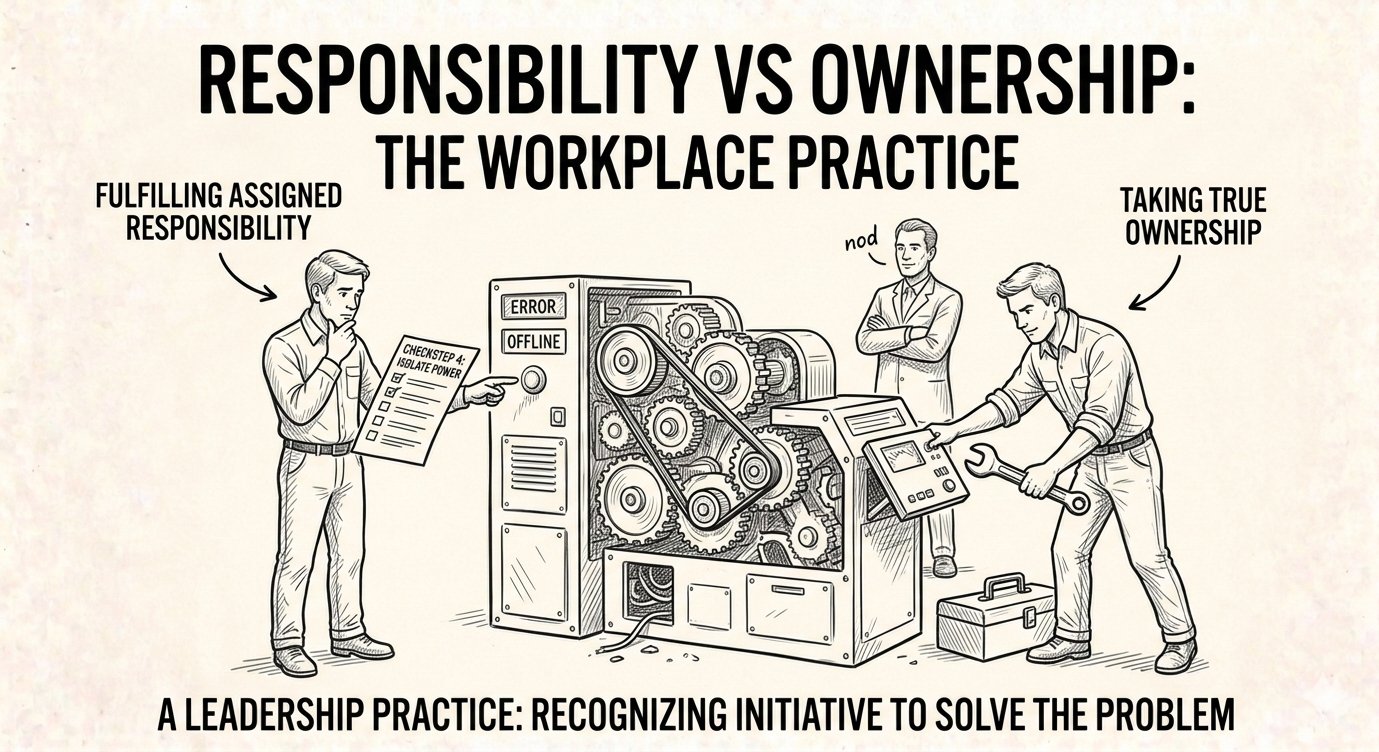
The distinction between ownership and responsibility represents one of the most critical leadership differentiators in modern organizations. While responsibility defines what you must do, ownership defines who you choose to become. Responsible employees complete assigned tasks; owners transcend boundaries to ensure collective success. This difference manifests in three revealing scenarios that separate exceptional leaders from merely competent managers.
Consider the functional lead who views success solely through departmental metrics. When engineering hits its sprint goals but the product launch fails, was engineering successful? True ownership demands a panoramic view. Leaders with genuine ownership instincts recognize that individual brilliance means nothing if the orchestra produces discord. They proactively reach across organizational silos, influencing peer functions and volunteering resources when bottlenecks threaten collective outcomes. This isn't about heroics-it's about understanding that your success is inextricably linked to the success of the whole.
The second scenario reveals ownership in its most uncomfortable form: the willingness to do work "beneath" your level. When a senior technical architect picks up mundane documentation tasks during a resource crisis, they're not diminishing their value-they're multiplying it. Corporate hierarchies often create invisible barriers where professionals refuse tasks outside narrow job descriptions, waiting for "appropriate" resources while projects languish. Contrast this with startup environments where titles become fluid and everyone does whatever accelerates progress. The difference isn't company size; it's ownership mentality. Leaders who truly own outcomes never invoke job descriptions as shields against urgent needs.
The third scenario-completing the original example-might involve discretionary decisions during business travel. When your flight gets delayed and you face a choice between an expensive same-day alternative or waiting until tomorrow, do you optimize for policy compliance or business impact? An owner asks: "What decision serves the project best?" They may absorb personal inconvenience or navigate policy exceptions because they're accountable to outcomes, not just procedures. This ownership mindset transforms how leaders approach every decision, replacing "Is this my job?" with "What does success require?" The shift from responsibility to ownership isn't semantic-it's the foundation upon which exceptional leadership is built.
Why This Matters
Organizations with ownership cultures outperform responsibility-focused competitors by significant margins because they eliminate the coordination tax that plagues siloed operations. When leaders wait for perfect role clarity or hide behind functional boundaries, opportunities evaporate and crises escalate while everyone points to someone else's responsibility. The cost isn't just delayed projects-it's the innovation that never happens, the customers who defect during cross-functional failures, and the talented employees who leave because they're tired of bureaucratic finger-pointing. Companies either cultivate ownership or they cultivate excuses; there is no middle ground.
Leadership in Practice
When a leading e-commerce and cloud company Web Services experienced a major outage in 2011 affecting companies like Reddit, Quora, and Foursquare, the response revealed ownership culture in action. Rather than having only the responsible network operations team address the crisis, engineers from completely different their cloud services division services voluntarily joined the war room. Senior principal engineers who typically architected future services spent hours manually rerouting traffic and restoring data. The founder and CEO had long established a culture where "Leaders are owners" was a core leadership principle-meaning leaders thought long-term, acted on behalf of the entire company, and never said "that's not my job." The critical moment came when a database specialist noticed that the restore process would take days using standard procedures. Without being asked, he rewrote replication scripts overnight-work far below his principal engineer level-cutting recovery time by 60%. This wasn't in his quarterly objectives or job description. When asked later why he did it, he simply said, "Our customers needed their data back." their cloud services division not only recovered faster than competitors would have but documented and shared their learnings publicly, further cementing customer trust. That single outage, handled with genuine ownership rather than defensive responsibility-shirking, became a case study in how ownership culture transforms crisis into competitive advantage. Today, their cloud services division's leadership principles explicitly state that owners "never say 'that's not my job,'" and this cultural pillar has been instrumental in their cloud services division growing to a $90 billion annual revenue business.
Leadership Framework
**The Ownership Activation Framework: From Responsible to Accountable**
**Step 1 - Expand Your Success Metrics:** Stop measuring yourself solely by functional KPIs. Define three critical metrics outside your direct control that impact overall success. Meet weekly with peer leaders to understand their constraints and offer proactive support before they ask. Success means the project wins, not just your piece.
**Step 2 - Eliminate "Not My Job" from Your Vocabulary:** Conduct a personal audit over two weeks. Each time you think "that's not my responsibility," note it. Then ask: "If I owned the company, what would I do?" Commit to taking one action weekly that falls outside your formal role but advances organizational goals. Make this visible to your team to model the behavior.
**Step 3 - Practice Discretionary Judgment Over Policy Compliance:** When facing decisions, apply the "Owner's Test": If you owned the company with your own capital at risk, what would you decide? This doesn't mean violating policies-it means understanding that policies serve outcomes, not the reverse. Document when ownership thinking leads you to challenge or navigate processes, and share the reasoning with leadership.
**Step 4 - Build Ownership Depth in Your Team:** Stop solving every problem yourself. Instead, give your team real ownership by transferring authority, not just tasks. When someone raises an issue, ask "What do you think we should do?" and "What support do you need to own this?" Celebrate when team members cross boundaries to drive results, even if execution isn't perfect.
**Critical Success Factor:** Ownership without boundaries becomes martyrdom. The goal isn't working 80-hour weeks doing everyone's job-it's creating a culture where everyone thinks like an owner within sustainable limits. Set the example by taking ownership decisively, then scaling through others.
**Warning:** In dysfunctional organizations, ownership can be exploited. If you consistently take ownership while peers hide behind responsibility, and leadership doesn't recognize or address the imbalance, you're not in an ownership culture-you're being taken advantage of. True ownership cultures reward and expect this behavior from everyone.
Leadership Takeaway
Starting tomorrow, replace the question "Did I complete my responsibilities?" with "Did I do everything possible to ensure our collective success?" This single cognitive shift transforms how you prioritize time, navigate organizational politics, and measure your contribution. The most powerful career accelerator isn't technical brilliance or charisma-it's consistently demonstrating that you think and act like an owner regardless of your title. Leaders who embrace genuine ownership don't wait for executive roles to behave like executives; they behave like executives until the organization has no choice but to recognize them as such.
"There is no limit to the amount of good you can do if you don't care who gets the credit." — Ronald Reagan (often cited in leadership contexts, originally attributed to various sources including Harry S. Truman)
Ramu Kaka's Wisdom
A gardener who only waters the plants in his assigned section will watch the entire garden wither during a drought. The wise gardener knows that a dying garden means his section dies too, so he tends to whatever needs tending, wherever it grows.
Reflection Questions
- In the past month, when did I avoid taking action on a critical issue because it fell outside my formal responsibilities, and what was the ultimate cost to the organization?
- If I were promoted two levels tomorrow, what would I suddenly start caring about that I'm currently ignoring—and why am I waiting for the title to demonstrate that level of ownership?
- Which of my team members demonstrates ownership beyond their role, and how have I visibly recognized and rewarded that behavior to reinforce the culture I want to build?