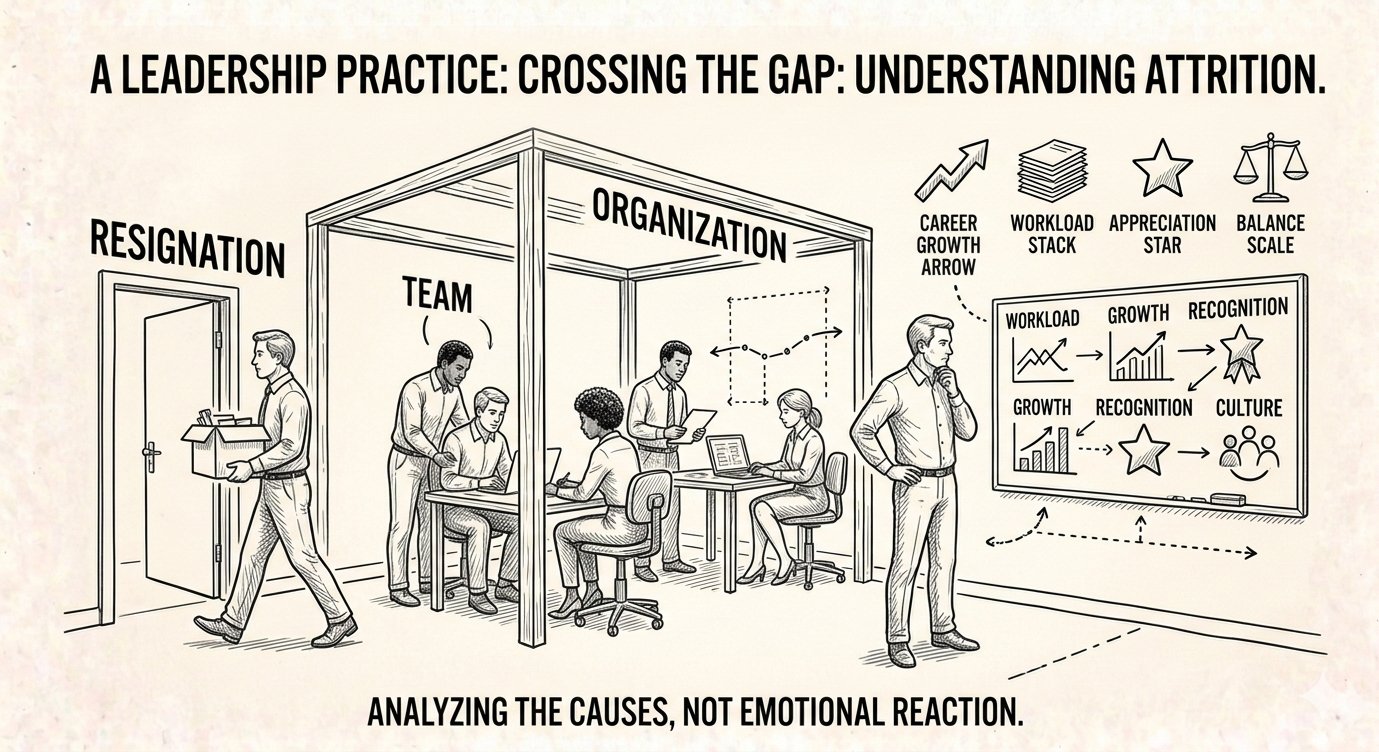
The psychology of employee departure follows a predictable yet often invisible trajectory that most leaders fail to recognize until it's too late. Understanding this journey-from discontent to decision-is one of the most critical skills a manager can develop, yet it remains one of the most overlooked aspects of leadership.
The departure process unfolds in three distinct stages, each with unique characteristics and intervention opportunities. Stage one begins when an employee experiences sustained dissatisfaction with their current role, whether stemming from compensation misalignment, cultural friction, poor management, or blocked career progression. During this critical phase, the employee remains psychologically tethered to the organization. They haven't yet committed to leaving; instead, they're hoping for conditions to improve. External factors-company performance, team stability, market uncertainty-create natural friction that delays action. This is your golden window for retention, when relatively modest interventions can dramatically shift outcomes. The tragedy is that most managers miss this stage entirely because the employee continues performing adequately while privately wrestling with their future.
Stage two marks a fundamental shift: the employee actively explores external opportunities. Life events-marriage, children, housing costs-can accelerate financial pressures that justify the search. A single toxic interaction with leadership can trigger immediate action for those dealing with cultural misalignment. For career-focused employees, organizational restructuring or the realization that their goals are unattainable internally serves as the catalyst. By this stage, the employee has mentally begun separating from the organization. While not impossible, retention becomes significantly more difficult and expensive. Astute managers may notice behavioral signals-unexplained absences, reduced engagement in long-term projects, or decreased participation in team activities-but in today's hybrid work environment, these clues are increasingly difficult to detect.
Stage three is closure: the employee has accepted an external offer and submits their resignation. At this juncture, counter-offers rarely succeed and often backfire, creating a temporary fix that leads to departure within six to twelve months. The relationship has fundamentally changed. The hard truth is that effective retention happens long before this moment-it's built through continuous connection, proactive career conversations, and organizational responsiveness to employee needs. Leaders who treat retention as a crisis response rather than a continuous practice will consistently find themselves reacting to resignations they should have prevented months earlier. The cost isn't just recruitment and training; it's institutional knowledge, team morale, and competitive advantage walking out the door.
Why This Matters
Employee attrition directly impacts your bottom line through recruitment costs averaging 50-200% of annual salary, productivity losses during transition periods, and the erosion of institutional knowledge that takes years to rebuild. More critically, high-performing employees rarely leave in isolation-their departure often triggers cluster resignations that can destabilize entire teams. Leaders who fail to recognize early-stage dissatisfaction don't just lose individual contributors; they lose their pipeline of future leaders and signal to remaining employees that the organization doesn't invest in retention until it's too late.
Leadership in Practice
When the new CEO became a major technology company CEO several years ago, he inherited an organization hemorrhaging top talent, particularly among engineers and product managers who felt stifled by internal politics and stack-ranking performance systems. The company's attrition rate among high performers had reached crisis levels, with many leaving for competitors like a major tech company and the company. The CEO recognized that exit interviews revealed symptoms, not causes-employees were leaving long before they submitted resignations. He implemented "connection" as a core leadership metric, requiring managers to conduct monthly career conversations separate from performance reviews. These weren't checkbox exercises but substantive discussions about individual aspirations, skill development, and organizational fit. The CEO personally modeled this behavior, holding skip-level meetings focused exclusively on employee growth rather than project updates. He eliminated the forced-curve ranking system that had created internal competition and replaced it with collaborative goals. Critically, he empowered managers to make retention decisions at the team level, providing budget flexibility for compensation adjustments, role redesigns, and lateral moves before employees entered the job market. The results were measurable: over the following years, the company's regrettable attrition rate among high performers dropped by 35%, and the company's reputation on employer review sites dramatically improved. More importantly, the culture shift enabled the company to retain the engineering talent necessary for their successful cloud transformation. The CEO's approach demonstrated that retention isn't about counter-offers; it's about creating conditions where employees never reach the decision to explore alternatives.
Leadership Framework
**The Early Detection Retention Framework (EDRF)**
**Stage 1: Establish Continuous Connection**
Schedule monthly 30-minute career conversations completely separate from performance discussions or project updates. Use the ACE structure: Aspirations (where does the employee want to be in 2-3 years?), Challenges (what obstacles do they face currently?), and Enablers (what resources or changes would accelerate their growth?). Document these conversations and track progress on commitments you make. Critical success factor: These cannot be delegated to HR or treated as optional during busy periods-inconsistency signals that you don't genuinely care.
**Stage 2: Monitor Leading Indicators**
Track behavioral patterns that signal stage-one dissatisfaction: decreased participation in voluntary activities, reduced contribution in meetings, withdrawal from social interactions, increased focus on task completion over innovation, or subtle changes in communication patterns. Create a simple monthly reflection: "Which team members am I worried about, and what specific evidence supports that concern?" Warning: Don't confuse introversion or personal life challenges with disengagement-verify your concerns through direct conversation, not assumption.
**Stage 3: Conduct Proactive Stay Interviews**
Quarterly, ask high-performers and critical team members: "What would make you leave?" and "What makes you stay?" This isn't about creating anxiety; it's about surfacing issues while you can still address them. The key is responding with action, not justification. If an employee expresses concerns about compensation, career path, or team dynamics, your response timeline matters-waiting for the next review cycle often means waiting too long.
**Stage 4: Build Retention Authority at the Manager Level**
Advocate for budget flexibility that allows spot bonuses, off-cycle raises, role adjustments, or project reassignments without requiring three layers of approval. Retention decisions made in days succeed; those requiring weeks of bureaucracy fail. Equip yourself with competitive market data so you can make informed decisions quickly.
**Stage 5: Create Graceful Exit Pathways**
Paradoxically, organizations that make internal mobility easy-allowing employees to explore different teams, functions, or locations-reduce external attrition. An employee who changes roles internally is a retention success, not a failure. Remove the stigma around internal exploration; the alternative is external exploration.
Leadership Takeaway
The most expensive retention strategy is the counter-offer; the most effective is the conversation that prevents the job search from ever beginning. Starting tomorrow, schedule 30-minute career conversations with each direct report focused exclusively on their growth, not your projects. Ask one question: "What would need to change for you to see your next three career moves happening here?" Then listen without defensiveness and commit to one specific action within two weeks. Retention is won in moments of connection, not crisis.
"People don't leave companies, they leave managers. But more accurately, they leave managers who never asked what they needed to stay." — Marcus Buckingham, leadership researcher and author
Ramu Kaka's Wisdom
The wise gardener doesn't wait for the plant to wilt before watering it. By then, the roots have already begun searching for moisture elsewhere. Tend to your people before they thirst, and they'll never need to look beyond your garden.
Reflection Questions
- When was the last time I had a conversation with each direct report focused exclusively on their career aspirations rather than current project deliverables, and what did I learn about their long-term satisfaction?
- If my three highest performers resigned tomorrow, would I be genuinely surprised, or have I noticed warning signs that I've been too busy or uncomfortable to address?
- What organizational barriers prevent me from making rapid retention decisions when I identify at-risk talent, and what specific actions can I take this month to increase my autonomy in this area?