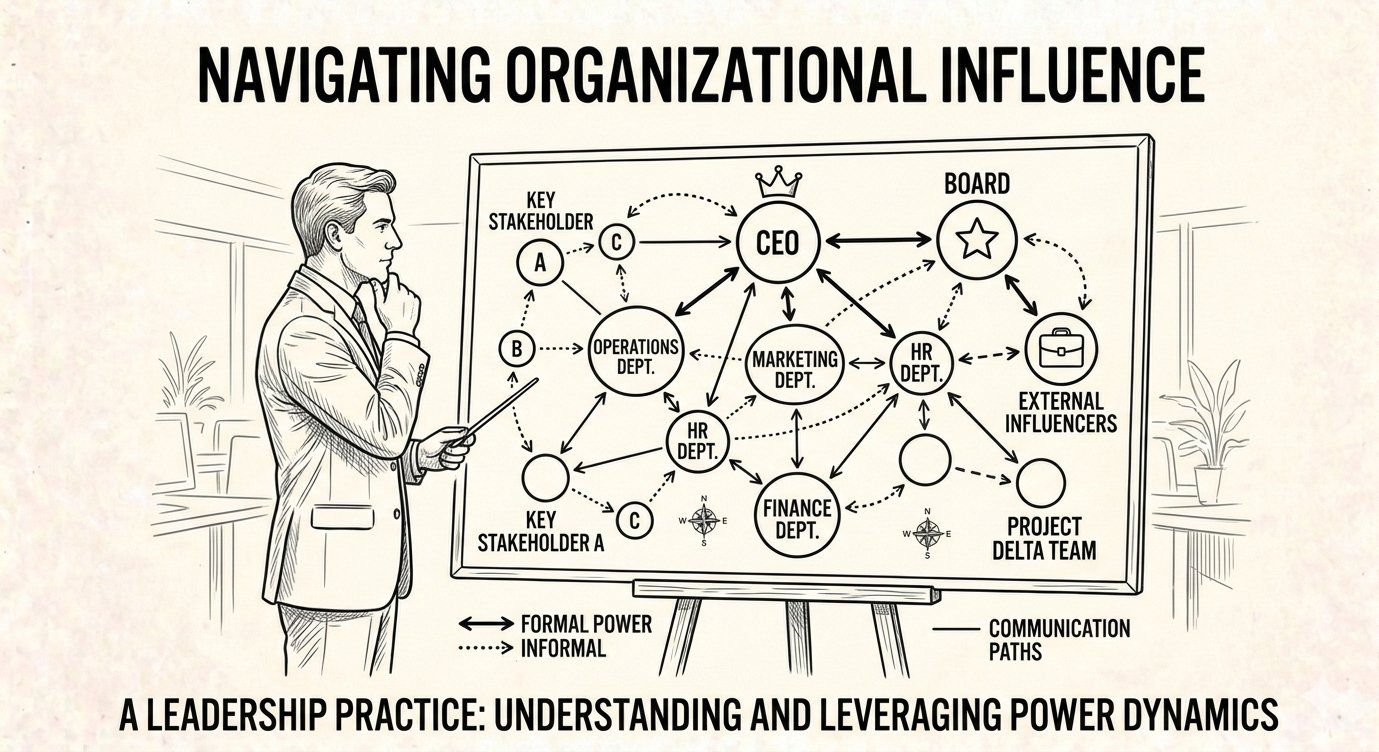
The most brilliant strategy dies in committee rooms, not because it lacks merit, but because its champions lack political competence. As Samuel Bacharach argues in 'Get Them On Your Side,' technical expertise and innovative thinking represent only half the leadership equation. The other half-often the determining half-is your ability to navigate the complex web of interests, agendas, and relationships that define every organization. Political competence isn't about manipulation or office intrigue; it's about situational awareness, coalition-building, and the sophisticated understanding that every stakeholder views your initiative through a fundamentally different lens.
Consider this uncomfortable truth: your transformative idea exists in competition with dozens of other priorities, each championed by leaders who believe just as fervently in their vision as you do in yours. Resources are finite. Attention is scarce. Organizational capital depletes quickly. In this environment, the leader who can map the political terrain-identifying natural allies, anticipating resistance, finding common ground, and building coalitions-doesn't just have an advantage. They have the only sustainable path to implementation. Political competence means recognizing what you can control versus what requires influence, knowing when to advance and when to consolidate support, and understanding that resistance to your idea often has nothing to do with its quality and everything to do with competing interests you haven't yet addressed.
The framework Bacharach presents centers on a deceptively simple 2x2 matrix analyzing stakeholders across two dimensions: their goals (aligned or misaligned with yours) and their approaches (compatible or incompatible with your methods). This model reveals four distinct stakeholder categories, each requiring different engagement strategies. Your natural allies share both your goals and approaches-nurture these relationships actively. Fence-sitters share your goals but question your methods-they need reassurance and involvement in shaping implementation. Opponents disagree with your objectives entirely-understand their concerns and seek compromise where possible, or prepare to work around them. The most dangerous group? Those who agree with your goals but fundamentally disagree with how you'll achieve them-these relationships require the most sophisticated political navigation.
Ultimately, building the team that will execute your vision requires you to first build the coalition that will approve and support it. This demands moving beyond the comfortable confines of like-minded supporters to engage skeptics, address legitimate concerns, and demonstrate that your initiative serves broader organizational interests. The leader who dismisses this work as 'office politics' and expects ideas to succeed on merit alone will find themselves consistently frustrated, wondering why lesser initiatives gain traction while theirs languish. Political competence isn't a nice-to-have soft skill-it's the hard skill that separates leaders who propose change from leaders who actually deliver it.
Why This Matters
Organizations don't fail because they lack good ideas-they fail because good ideas never gain sufficient support to be implemented effectively. Research shows that up to 70% of strategic initiatives fail not due to flawed strategy, but due to poor execution rooted in inadequate stakeholder alignment. When leaders lack political competence, they waste months developing perfect plans that die in their first meeting, they alienate potential allies through tone-deaf engagement, and they allow small pockets of resistance to derail transformative initiatives. In an era where speed and adaptability determine competitive advantage, the ability to rapidly build coalitions and mobilize support isn't optional-it's the difference between leading change and watching it happen around you.
Leadership in Practice
When the new CEO assumed the CEO role at a major technology company several years ago, he inherited a company fracturing along divisional lines, where product groups actively undermined each other to protect their territories. The Windows division had famously torpedoed promising mobile initiatives that threatened their dominance, while Office and their cloud platform pursued incompatible strategies. The CEO recognized that his vision of a cloud-first, mobile-first the company would face resistance not because it was wrong, but because it threatened established power structures and deeply held beliefs about what made the company successful. Rather than forcing his agenda top-down, the CEO demonstrated exceptional political competence by systematically mapping the terrain and building coalitions. He identified natural allies in the cloud platform team who shared his cloud vision. He engaged fence-sitters in Windows by showing how cloud services enhanced rather than cannibalized their platform. He addressed the concerns of Office traditionalists by demonstrating that cross-platform availability expanded rather than diminished their market. Most critically, he reframed the company's culture around a 'growth mindset,' making it psychologically safe for leaders to embrace change without admitting their previous strategies were failures. Within five years, the company's value increased substantially, not because the CEO had better ideas than his predecessors, but because he built the coalitions necessary to execute them. He understood that the team you build-and how you build it-ultimately defines what you can accomplish.
Leadership Framework
**The Political Terrain Navigation Framework**
**Step 1: Stakeholder Mapping (Goals × Approaches Matrix)**
Before launching any initiative, create a comprehensive stakeholder map using the 2x2 matrix: Plot each key stakeholder based on whether they share your goals (yes/no) and whether they support your approaches (yes/no). This creates four quadrants: Champions (shared goals + shared approaches), Scouts (shared goals + different approaches), Opponents (different goals + different approaches), and Saboteurs (different goals + shared approaches). Update this map regularly as positions shift.
**Step 2: Coalition Architecture**
Start with your Champions-secure their active, vocal support early. Then focus disproportionate energy on Scouts, as they represent your highest-ROI opportunity. Invite them into your planning process, genuinely incorporate their methodological concerns, and transform them into co-creators rather than critics. Document how their input shaped your approach. For Opponents, seek to understand their underlying interests-sometimes what appears as opposition to your goal is actually protection of a competing priority that could be addressed differently.
**Step 3: Resistance Anticipation**
For each major stakeholder group, explicitly write out the three most likely criticisms they'll raise about your initiative-both substantive concerns about your idea and personal concerns about you or your motives. Prepare responses that acknowledge legitimate concerns while demonstrating you've thought beyond surface-level solutions. This preparation prevents you from becoming defensive when criticism emerges and allows you to respond with empathy and evidence.
**Step 4: Sequential Engagement Strategy**
Don't treat all stakeholders equally or simultaneously. Engage Champions first to refine your message, then Scouts to broaden your coalition, then carefully selected Opponents to demonstrate openness and identify possible compromises. Each conversation should reference previous support you've gained, creating momentum and social proof. Time your wider organizational launch only after you've secured sufficient coalition strength to weather initial resistance.
**Step 5: Coalition Maintenance**
Political terrain constantly shifts-allies leave, priorities change, new information emerges. Schedule regular check-ins with coalition members, share credit generously for early wins, and remain genuinely open to course corrections. The leader who builds a coalition and then ignores it will find support evaporating precisely when it's needed most.
**Critical Success Factor:** Political competence requires authentic relationship-building, not manipulation. Leaders who view this framework as a way to trick people into supporting bad ideas will ultimately fail. The goal is to genuinely understand diverse perspectives, find legitimate common ground, and build something stronger through collaboration than you could have achieved alone.
Leadership Takeaway
Starting tomorrow, before you pitch your next initiative, invest equal time in mapping the political terrain as you did in developing the idea itself. Identify three key stakeholders who share your goals but question your approach, and schedule conversations focused on listening rather than convincing. The quality of your ideas matters far less than your ability to build coalitions around them-and coalition-building is a skill you can develop systematically. Remember: you're not defined by the initiatives you propose, but by the teams you build to bring them to life.
"If I have seen further, it is by standing on the shoulders of giants." — Isaac Newton, reminding us that even history's greatest breakthroughs required building on the work and support of others
Ramu Kaka's Wisdom
The farmer who plants seeds without preparing the soil shouldn't be surprised when nothing grows. Similarly, the leader who launches initiatives without cultivating relationships shouldn't wonder why nothing takes root. Great ideas need fertile ground-and that ground is made of the people who'll help you succeed.
Reflection Questions
- When was the last time a great idea of yours failed to gain traction—and how much of that failure was due to inadequate coalition-building rather than flaws in the idea itself?
- Who are the three most influential stakeholders who share your goals but question your methods, and what would happen if you genuinely invited them to shape your approach rather than just support it?
- If you were completely honest, do you spend more time perfecting your ideas in isolation or building relationships with the people who'll determine whether those ideas ever see daylight?